Wisdom Bank - Aarushi Agarwal: The Mindset Behind the Medals
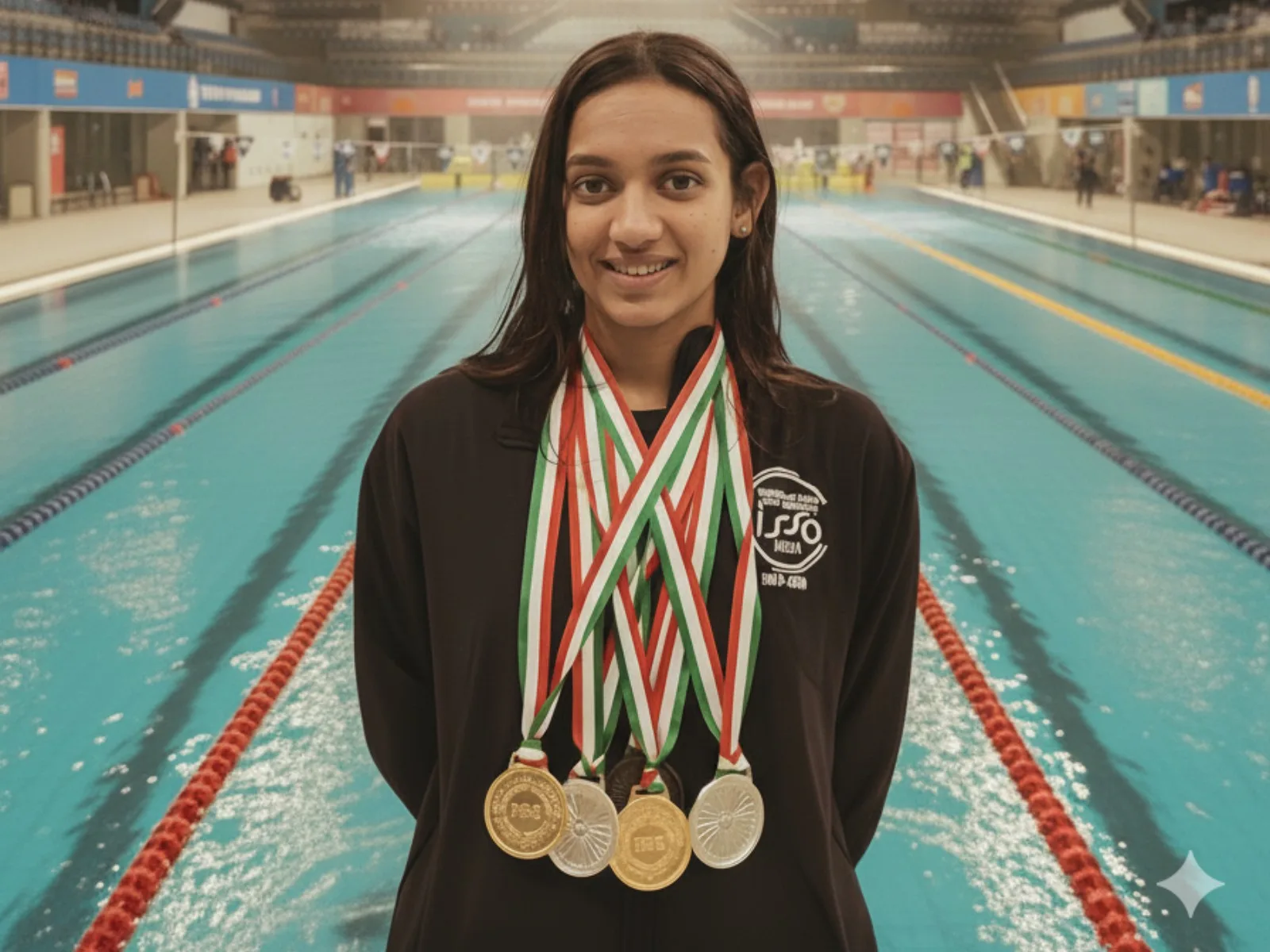
Why do some people seem to have it figured out so early?
Not in the “they’ve won a bunch of medals” kind of way — but in the way they speak, reflect, and carry themselves. The kind of person who, even at 17, sounds like they’ve lived twice that.
That’s what you notice first about Aarushi Agarwal.
Yes, she’s a national-level swimmer. Yes, she’s been waking up at 4:45 AM for years to train before school. And yes, she’s dealt with pressure, pain, and missed opportunities. But what makes her story stand out isn’t just her achievements — it’s her mindset.
At an age where most people are still figuring out who they are, Aarushi talks about identity beyond swimming, about detachment from comparison, about how every setback is just a redirection. She’s not reciting motivational quotes — she’s living them. And she’ll be the first to admit, that didn’t come easy.
This isn’t just a story about swimming. It’s about what it means to rebuild, refocus, and redefine yourself — even before your 18th birthday.
Becoming Aarushi
Most people discover discipline later in life. Aarushi Agarwal met it somewhere between 4:45 AM wake-up calls and after-school swim practice.
Her day started before sunrise. “I used to call it night,” she says, laughing, “but now it’s just morning.” Wake up. Swim. School. Swim again. Study. Repeat.
It wasn’t pressure from others that got her in the pool that early. It was something else entirely: a love for the process. Aarushi doesn’t swim just to win — she swims because she’s addicted to becoming better. Not better than others. Better than she was yesterday.
Ask her about medals and she shrugs. “It’s not about gold, silver or bronze. I just want to see if I can reach my own goals.” That’s the real fuel behind her discipline. She’s not chasing validation. She’s chasing potential.
And right at the heart of that consistency is her mum. She’s the one who preaches consistency — and lives it. For four to five years, she woke up an hour earlier than Aarushi every single day to prepare everything needed for training, and she picked and dropped her to practice without fail. That level of motivation and determination didn’t just support Aarushi — it shaped her. Aarushi says it plainly: her mum is the main reason behind her performance at the pool.
Her dad was the planner, the driver, the strategist — the one who gives advice without emotion. “Just facts,” she says. Together, her parents built a foundation where high standards met unwavering support.
This support system gave Aarushi something rare: the space to push herself. The pressure she talks about isn’t the crushing kind — it’s the kind that sharpens focus. And it’s the kind that, in her words, “makes the feeling of achievement so much more rewarding.”
She had built resilience long before she needed it most.
Pressure, Setbacks & the Unseen Weight
If you only looked at the medals, you’d think Aarushi was always winning.
But every win came with pressure — not just from coaches or selection trials, but from within. “If there’s no pressure,” she says, “then you’re not expecting enough from yourself.”
That mindset drove her forward — but it also meant that setbacks cut deep.
Like the time she was supposed to go to her first Nationals. Her training was on point. Her selection seemed certain. And then — a fraction of a second changed everything.
Another swimmer had swum 0.01 seconds faster than her — not in the official event, but during the relay trials. Initially that time wasn’t considered, but after a review, Aarushi was asked to step aside. Her Nationals debut vanished overnight.
It was crushing. But it wasn’t the end.
Because missing Nationals meant Aarushi could enter the South Zone meet. There, she turned her disappointment into fuel and broke all the backstroke records.
And not long after, the full-circle moment arrived. She qualified for Nationals and, in her individual event — the 50m backstroke — she won Bronze.
The very loss that had shut one door had opened another, preparing her for the stage she’d dreamed of.
The Shoulder Injury – When Everything Stopped
It started like nothing at all.
Aarushi thought she’d just dislocated her shoulder. She popped it back in, cried a little, and assumed she’d be fine. Even the physio called it a sprain. A few weeks later, she was back in the pool, pushing herself harder than ever.
“I was in the zone,” she remembers. “I had just finished exams and I was ready to give this whole year to swimming.”
But then came the news: a labrum tear. A serious injury that had been causing repeated dislocations — and now needed surgery.
“I didn’t believe it at first,” she says. “It felt surreal. Like, this can’t be happening.”
Everything went blank. No races. No routines. Just a silence she wasn’t used to.
“I had a sort of breakdown. I just let the emotions flow. I couldn’t even think.”
For someone whose life had always been structured around the next goal, the next competition — this was like staring into a void.
But even then, something inside her shifted.
She turned to her father and said: “I’m going to use this time productively.”
Detachment & Redirection
In the weeks after surgery, Aarushi wasn’t racing anyone — not even herself.
With no competitions ahead, and no daily training schedule, she found herself in unfamiliar territory. At first, she still checked updates, wanting to see what her peers were doing. But over time, the urge faded.
“It wasn’t about them anymore,” she says. “It was just me. My recovery. My progress.”
She began strength training, ran a little, eased back into the pool. More importantly, she started to enjoy the stillness.
Before the injury, swimming was her entire identity. Now, she had space to explore other parts of herself — time with family, learning new things, understanding who she was beyond the sport.
“I realised I was grateful for the time,” she says. “Because without being forced to stop, I probably never would’ve taken it.”
Sometimes, growth doesn’t come from pushing harder. It comes from standing still long enough to see where you really are.
The People Who Shape You
Behind Aarushi’s calm strength is a support system that never wavered — even when she did.
Her mum is the rhythm and the reason — the one who champions consistency, who woke an hour earlier for years to prep, who picked and dropped her to practice daily, whose motivation and determination made Aarushi’s consistency possible. In Aarushi’s words: she’s the main reason behind my performance at the pool.
Her dad? He’s the structure. The driver. The analyst. The person who’ll spot weaknesses not to criticise — but to fix.
“If my strength was off, he’d find a trainer. If my diet was off, he’d talk to a nutritionist. He always had a plan,” Aarushi explains.
And yes — there was pressure. Timings to meet. Goals to hit. But she doesn’t resent it.
“I like the pressure,” she says. “Because the feeling after — when you’ve achieved something — that’s what makes it worth it.”
Support doesn’t always sound like “you’ve got this.” Sometimes it looks like spreadsheets, routines, and 4 AM drives — all built on belief.
What You Can Learn from Aarushi
Aarushi’s story isn’t just about swimming. It’s about mindset. Grit. Self-awareness. And the courage to pause when everything in you wants to push.
Here’s what you can take from her journey:
1. Setbacks aren’t dead ends. They’re redirections.
Missing Nationals opened the door to South Zones — where she broke records. That same path led her to Nationals the next year, and a place on the podium.
2. Detach from comparison. Focus on your own lane.
Progress isn’t measured by what others are doing. It’s measured by how far you’ve come.
3. Discipline isn’t just for the good days.
It’s what you do when no one is watching — and when everything feels off — that builds resilience.
4. Support doesn’t always sound like a pep talk.
Sometimes it’s quiet. Sometimes it’s blunt. But it’s there — and it matters more than you think.
5. Pressure can be fuel.
Used wisely, it sharpens your focus and raises your game. You don’t need to run from it. You just need to understand it.
6. You’re more than your sport, your job, or your goals.
When swimming was taken away, Aarushi didn’t fall apart. She expanded.
Final Thoughts: Strength Looks Different Than You Think
You don’t need to have it all figured out to keep going.
You don’t need to be the fastest, the strongest, or the most motivated every single day. And you definitely don’t need to pretend it’s easy.
What Aarushi Agarwal reminds us is that strength isn’t always loud. Sometimes it’s in how you pick yourself up after hearing “you need surgery.” Sometimes it’s in choosing to stop comparing. Sometimes, it’s in saying: “This is hard… but I’ll keep moving anyway.”
She may only be 17, but Aarushi has learned something many adults spend a lifetime chasing — how to step back, reset, and come back stronger. Not in spite of the setback. Because of it.
Whether you’re an athlete, a student, a parent, or just someone in a tough spot — her story is a reminder that growth isn’t linear, and identity isn’t limited to what you do.
There’s always a way forward. And sometimes, the pause is the progress.
By Ugesh Sarcar