Wisdom Bank - Avinash Mokate And The Question That Wouldn't Let Him Sleep
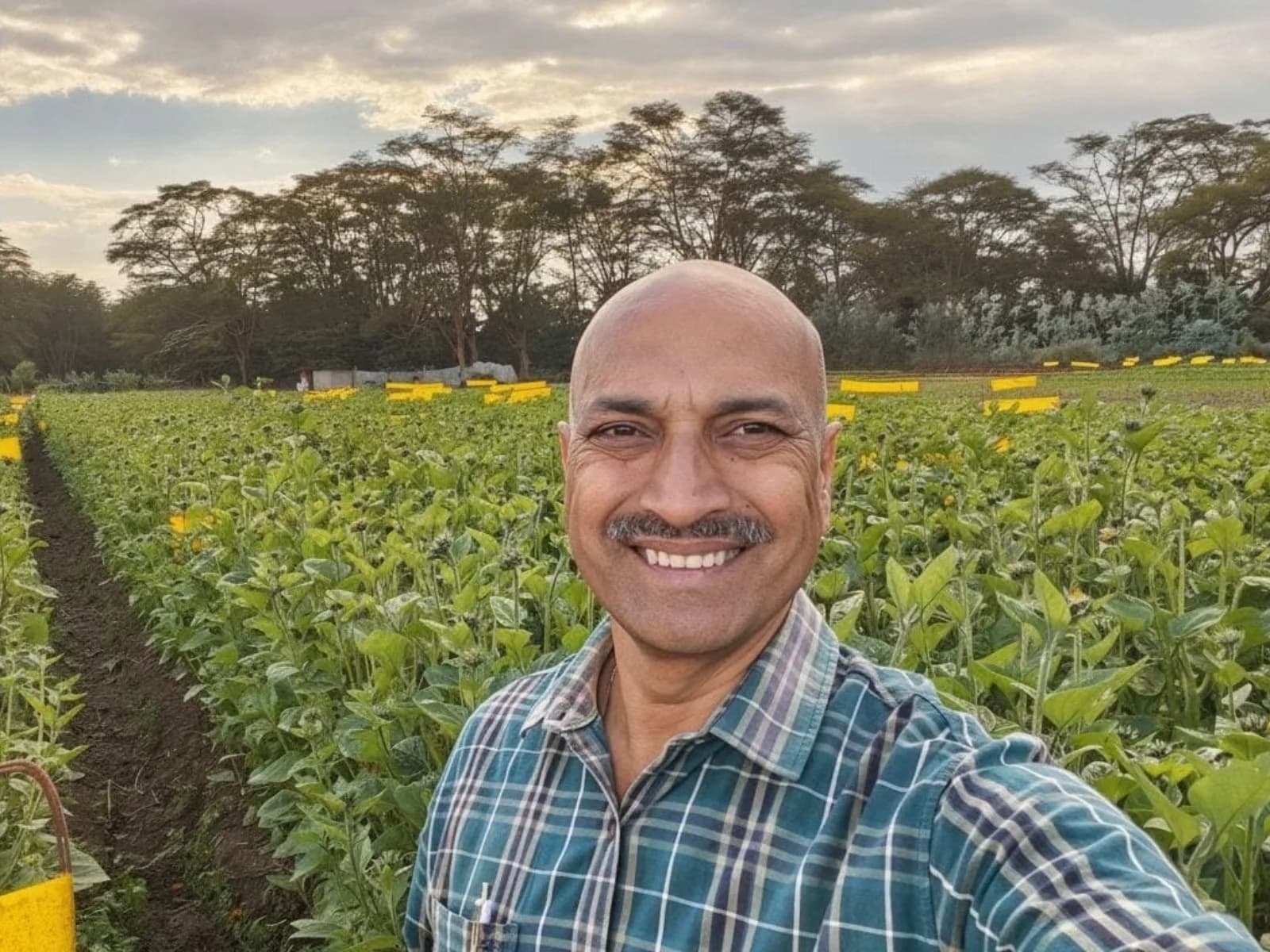
Sometimes the biggest turning point in your life begins with a question you can't answer.
It was three o'clock in the morning. The house was silent, his family asleep upstairs. Alone in the bathroom of his home in Quito, Ecuador, Avinash Mokate sat on the floor and broke down.
Just a few years earlier, life had looked exactly as he had planned. He had built a successful international career in horticulture, working across South America for a Dutch company that was expanding rapidly, travelling constantly and helping grow a business built around developing and licensing new varieties of roses. Professionally, he was exactly where years of hard work were supposed to lead.
Then everything unravelled. The 2008 financial crisis hit, and flower growers stopped paying their royalties. Close to four or five million dollars that should have flowed back into the business never arrived, and expansion became survival.
At the same time, a new greenhouse project began to fail. Not because the team had forgotten how to grow flowers, but because they could no longer afford the fertilisers and pesticides they had always relied on. Standing inside that greenhouse, watching the crop struggle, a thought lodged itself in his mind: if forests can grow without human intervention, why can't our farms?
It wasn't a passing curiosity. It was a question that refused to leave.
Soon afterwards, the company filed for bankruptcy. Then came another blow: the company's owner passed away after battling cancer. None of it made sense. He had worked hard, followed every principle he'd been taught, done everything right, and yet everything still fell apart.
Sitting alone on that bathroom floor, he found himself asking the only question that mattered: what am I missing? That question would reshape the next sixteen years of his life, carrying him from South America to India, then to Kenya, and challenging everything he had learned about agriculture, success, and the purpose of work itself.
Today, many people know Avinash as an advocate for regenerative agriculture. But that isn't really what this story is about. This is the story of what happens when one unanswered question quietly rewrites your life.
Success Was Never the Real Story
Looking back, it's tempting to treat the collapse of Avinash's career in Ecuador as the defining moment of his story. It wasn't. It was simply the moment that exposed a deeper problem.
For years, he had believed what most agricultural professionals believed: that you grow healthy crops by managing the right inputs. Fertilisers, crop protection, standard operating procedures. Control the variables, and the outcome should follow. That wasn't just his opinion; it was the foundation of everything he'd been taught.
Then the money disappeared, and without the usual inputs, the greenhouse couldn't perform as expected. Watching those crops struggle forced him to confront something he had never seriously questioned before: why should a crop need constant human intervention to survive when a forest needs none? The question unsettled him because it challenged his education, not just his experience.
Most people would eventually move on: find another job, blame the financial crisis, treat it as bad luck. Avinash couldn't. The greenhouse had planted a question far more persistent than the flowers ever were, and it followed him even after he left South America, even after he returned to India, even after he began a new chapter of his career.
When Work Became Worship
Around the same time, another unexpected encounter changed the way he understood that question. A spiritual teacher came to stay at his home in Ecuador, asking only that the household avoid non-vegetarian food during her stay. Avinash agreed, expecting a guest. He didn't expect a turning point.
For years he had been reading spiritual writers like Swami Vivekananda and Paramahansa Yogananda. Their books fascinated him, but many of the questions he carried about purpose and suffering remained unanswered. This conversation was different. Through the teacher, he was introduced to the man who would become his spiritual master, Jagadguru Shri Kripaluji Maharaj, and something clicked.
The business collapse stopped feeling like an isolated professional failure. Instead, it became part of a much larger lesson. Until then, work and spirituality had occupied separate spaces in his mind: one paid the bills, the other searched for meaning. For the first time, he realised they didn't have to compete.
"My spiritual journey has become a journey in agriculture," he says. "I am serving my spiritual hunger through agriculture." It's an unusual way to describe a career, but it explains why his search never ended once he left Ecuador. He wasn't simply looking for a better way to farm. He was searching for a better way to live.
Looking for Answers
Returning to India didn't bring closure; it deepened the search. He began reading more widely, looking online for anyone asking the same questions that had kept him awake years earlier. Eventually that search led him to Padma Shri Subhash Palekar, one of India's leading voices on natural farming.
What Avinash encountered challenged almost everything he had learned through formal agricultural education. Instead of asking how to improve agriculture through more intervention, natural farming asked whether many of those interventions were creating the problems they claimed to solve. He attended lectures, read extensively, observed. Then he returned to Kenya, where he was managing commercial flower farms, and began experimenting with these ideas himself.
People thought he'd lost his mind. This was the same man who had spent decades working within conventional agriculture, now questioning the very practices that had built his career. Some laughed, others dismissed him, and he understood why, because years earlier he probably would have reacted the same way. But curiosity had grown stronger than certainty, so he kept learning, seeking out farmers, researchers and practitioners across India, Australia, New Zealand and the United States.
One idea kept surfacing: agriculture isn't a factory. Factories succeed because every input can be controlled; agriculture can't. Every day, crops respond to changing temperatures, sunlight, humidity, rainfall, microbes and insects, countless interactions beyond human control.
"You can only create the environment," Avinash says. "You cannot control it." That simple observation became the foundation of everything that followed, not just in farming but in life. Once you stop trying to control nature, you begin learning how to work with it.
Seeing What Others Couldn't
By the time Avinash returned to Kenya, he no longer believed agriculture needed better products. He believed it needed better questions. The more he observed crops, soils and ecosystems, the more convinced he became that modern farming had grown obsessed with treating symptoms instead of understanding causes.
For decades, agriculture had answered every new problem with another input. A pest appeared, so growers sprayed it. The soil weakened, so they added fertiliser. A disease spread, so they found another chemical. Each solution solved the immediate problem while quietly creating another one.
Avinash began wondering what would happen if farmers stopped asking "what should I add?" and started asking "what have I disrupted?" That question changed the way he looked at everything.
Understanding the System
One of the biggest shifts in Avinash's thinking was moving away from seeing agriculture as a collection of individual problems, toward seeing it as one interconnected living system. He often explains this through the five elements: earth, water, fire, air and space, which he believes are constantly interacting whether you're standing in a forest or a flower farm. When they're in balance, nature regulates itself; when one is disturbed, the others eventually follow.
From his perspective, modern agriculture has gradually disrupted that balance. Excessive fertilisers alter the soil. As the soil changes, water behaves differently, and the tiny pockets within it that allow roots, microbes and oxygen to coexist begin to change too. Eventually, the plant itself changes.
To Avinash, this isn't simply about lower yields. It's about weaker life. Whether or not every part of that framework aligns with mainstream scientific thinking, it explains why he approaches agriculture so differently today: his goal isn't to force higher production, but to rebuild the conditions that allow nature to function as it was designed to. If the system itself is unhealthy, adding more inputs can only mask the symptoms for so long.
The Idea People Never Forget
Every teacher has one idea that people remember. For Avinash, it's what he calls "constipated plants." The phrase usually makes people laugh, then it makes them think.
He argues that many modern crops never complete their natural biological processes, pushed along by synthetic inputs or harvested before reaching full maturity. On the outside they look perfect: bright, clean, uniform. Inside, he believes something is missing, like people surviving rather than thriving.
The plant may have produced fruit, but in his telling it never had the chance to become fully healthy. A plant fighting pests or disease hasn't completed its photosynthesis properly, and gets sprayed clean rather than allowed to finish that process. That's why he calls it "constipated," not physically blocked, but prevented from completing the natural cycle that gives food its full vitality. He believes that when people repeatedly eat food grown this way, they end up carrying that same incompleteness in themselves.
Whether readers agree with the conclusion or not, the metaphor captures something important about how Avinash sees the world. He's less interested in appearances than in function, less interested in short-term perfection than long-term health. The crop simply reveals the condition of the system that produced it.
When the Questions Became Personal
Several years ago, at an event in the Netherlands, Avinash met a young podcaster who had built a growing audience around conventional agriculture. Avinash challenged him directly: with that platform, why not introduce farmers and researchers exploring healthier, regenerative ways of growing food instead? The podcaster wasn't convinced. Like many people, he believed conventional agriculture was simply the practical reality. The conversation ended, and neither man changed the other's mind. Or so it seemed.
Nearly two years later, the podcaster called again, this time wanting Avinash on his show. For hours they spoke about food, farming, and the relationship between soil health and human health: the greenhouse, the forests, the search for balance, the idea of "constipated plants." When the conversation finished, Avinash flew home assuming it would become one more interview among many.
That night, his phone rang. It was the podcaster's father, calling to thank Avinash for the conversation, and to share something deeply personal. His son had been diagnosed with Stage 3 cancer, and listening to the discussion had made him start asking questions about food and health he'd never seriously considered before. Soon afterward, the father travelled to Kenya himself to see Avinash's work firsthand.
For Avinash, the moment wasn't proof that he was right. It was something more human: a reminder that people rarely change because they lose an argument. They change because a question quietly refuses to leave them, just as one had refused to leave him all those years earlier.
It Doesn't End at the Farm
That way of thinking shapes far more than agriculture. It shows up in the smallest moments of everyday life. Visiting a friend's home once, Avinash heard the whistle of a pressure cooker from the kitchen and walked in to see what was being used. It was aluminium, and he pointed it out immediately, not to criticise the meal, but because in his view, extraordinary care on the farm means little if the final stages of preparing food undermine it.
Whether the subject is soil biology, crop management, or cookware, he keeps returning to the same principle: health is rarely determined by one dramatic decision. It's shaped by hundreds of small ones, each moving us either a little closer to nature or a little further from it.
By now, Avinash had stopped seeing agriculture as an industry. He saw it as a reflection of the choices people make every day. The real challenge, he realised, was never helping people understand the ideas. It was helping them choose to live differently, and that turned out to be the hardest lesson of all.
The Hardest Lesson Had Nothing to Do with Farming
By this point, Avinash had spent years questioning agriculture, and what surprised him was that farming turned out to be the easy part. People were harder. He had watched conventional assumptions unravel inside a failing greenhouse, searched for different answers, tested them on commercial flower farms, and built an entirely new way of thinking about food and farming. Naturally, he wanted to share what he had learned.
Instead, he found resistance. Some people laughed, others dismissed regenerative agriculture before they understood it, and many simply carried on doing what they had always done. For a while, that frustrated him. If the evidence was there, why wouldn't people listen?
Then one day, another question interrupted his thinking: if he couldn't even convince his own family to do everything he believed was right, how could he expect to convince the world? The answer changed him, not because he stopped believing in his work, but because he finally stopped believing that changing people was his responsibility.
Letting Go of the Outcome
That realisation didn't come from agriculture. It came from spirituality. As his understanding deepened, Avinash often found himself returning to a lesson from the Bhagavad Gita: do your work, do it honestly, do it wholeheartedly, but don't become attached to the outcome. For years those words had sounded philosophical. Now they became practical.
He often reflects on the story of Krishna revealing his divine form to Duryodhana before the great war. If witnessing God himself wasn't enough to change one man's heart, Avinash reasons, what chance does any ordinary person have of changing another through argument alone? The story comforts him, not because it excuses inaction, but because it removes the burden of control.
His responsibility, he decided, isn't to make people agree. It's to keep doing what he believes is right, share what he's learned, remain open to learning more, and trust that every person will respond in their own time. Ironically, that made him a better teacher. The need to persuade disappeared, and curiosity took its place.
Becoming a Student Again
Perhaps the most revealing thing Avinash said during our conversation wasn't about agriculture at all. After decades working across India, South America and Africa, after managing commercial farms, after studying alongside farmers, researchers and mentors around the world, he offered a conclusion that sounded almost childlike: "The more I study, the more I feel I am such a small child."
Most people assume expertise leads to certainty. For Avinash, it led to humility. Agriculture taught him something that applies far beyond farming: factories reward control, but nature rewards attention. You cannot command a seed to grow, negotiate with the weather, or write a standard operating procedure for life. You can only prepare the conditions, observe, adapt, and wait.
The same, he believes, is true of people. You cannot force trust, rush healing, or demand transformation. You can only create the conditions in which it becomes possible. Looking back, that's exactly how his own life changed: not through one conversation or one book, but through one unanswered question slowly leading to another. A business collapse. A spiritual teacher. A different understanding of agriculture. Years of observation. Countless conversations. None of those moments seemed extraordinary on their own. Together, they became a different life.
The Morning Question
Towards the end of our conversation, I asked Avinash what still drives him: after the failures, the criticism, the years spent questioning what he once accepted without hesitation, what keeps him moving forward? His answer came immediately. Every morning, he wakes up asking himself the same question: what can I do today to make agriculture better? Not someday. Not when the world catches up. Today.
It's a deceptively simple habit. Most of us wake up thinking about our calendar, our emails, our deadlines. He begins with purpose, not because he believes he'll change agriculture single-handedly, but because he's already accepted that many people will disagree with him, dismiss his ideas, or never change at all. And that's okay. His job isn't to control what other people believe. It's to keep learning, keep observing, keep asking better questions than he asked yesterday.
Listening to his story, I realised something. When we think about conviction, we often picture certainty: someone who has all the answers, someone who never doubts themselves. Avinash's conviction looks very different. It begins with doubt, grows through curiosity, and survives because he's willing to remain a student.
Perhaps that's why his story stays with you long after it ends. It isn't really about regenerative agriculture, nor simply about spirituality; those are only the landscapes through which the story travels. At its heart, this is a story about questions. One question inside a failing greenhouse challenged everything he thought he knew. Another, asked on a bathroom floor at three in the morning, forced him to reconsider the purpose of his life. Years later, another reshaped the beginning of every single day.
What can I do today to make agriculture better?
The questions changed. The habit never did.
Some questions demand quick answers. The important ones rarely do. They stay, they challenge you, they reshape you quietly over years. The question that wouldn't let Avinash sleep never really disappeared. It simply became the compass by which he now lives.
And maybe that's the question this story leaves with you: what question is quietly shaping your life?
By Ugesh Sarcar