Wisdom Bank - The Voyage of Dilip Srinivasan: A Life at Sea, A Legacy on Land.
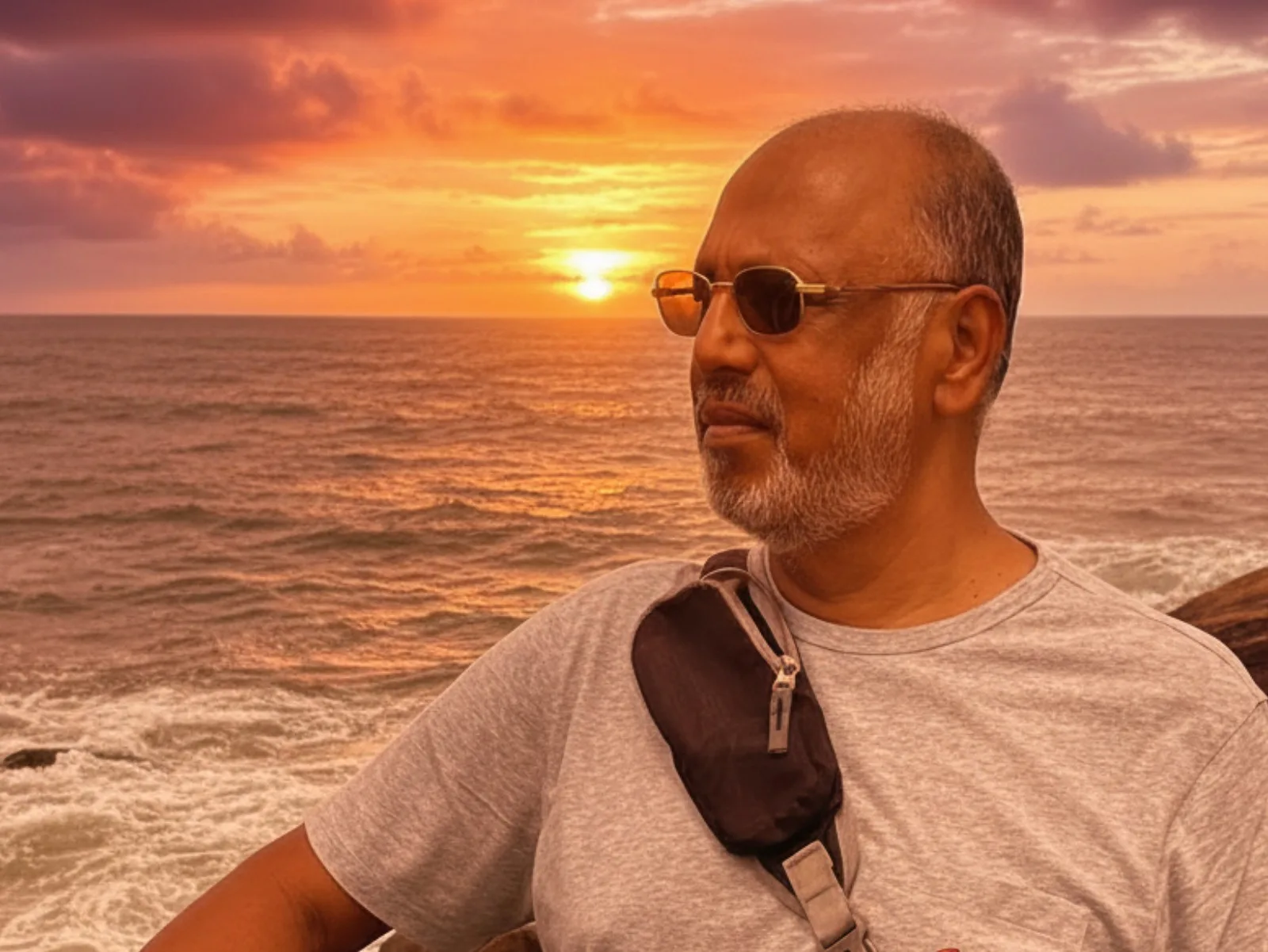
Ever wonder how some people stay calm in a crisis while others fall apart?
They don’t panic. They don’t make excuses. They just… handle it.
Dilip Srinivasan is one of those people. But he wasn’t born with nerves of steel — he earned them the hard way.
At just 16, he left his home in Coimbatore and stepped onto a government training ship in Mumbai. He didn’t speak Hindi. He’d never left home. And he had no idea what was coming. The food was bad. The discipline was brutal. The ragging — physical and mental — was relentless. But he stayed.
Not because it was easy. But because something in him had already been shaped by a different kind of upbringing — one that taught him to stand on his own, make his own decisions, and take responsibility for whatever came next.
That mindset carried him across decades at sea as a ship captain, into the boardroom as a senior operations leader, and finally into the classroom — where he now trains the next generation of seafarers as a professor in Chennai.
This isn’t just a story about the Merchant Navy. It’s about how early independence, tough choices, and quiet resilience shape the kind of person who can weather any storm — literal or otherwise.
A Different Kind of Upbringing
Dilip Srinivasan didn’t grow up in a big city, or attend elite schools. He grew up in Coimbatore, in a modest, middle-class home — no frills, no hand-holding. And that made all the difference.
Unlike today’s hyper-involved parenting style — where every meal is monitored, every tuition class scheduled — Dilip’s parents largely left him to figure things out on his own. Not in a neglectful way, but in a way that quietly signalled: “We trust you.”
As long as he stayed out of trouble and did reasonably well, they didn’t interfere. That early freedom to make his own decisions — and deal with the consequences — gave him something many young people struggle to develop: a sense of ownership over his own life.
If he did something good, the credit was his. If he messed up, he faced the music. No blaming, no excuses.
This sense of personal responsibility became the bedrock of his mindset — not just at home, but later in high-stakes environments out at sea, where mistakes can cost lives and there’s no one else to lean on.
And it’s a principle he’s passed on. From the time his daughter was four, she packed her own suitcase when they travelled. Today, she’s fiercely independent — just like he was raised to be.
Looking back, Dilip sees this kind of upbringing as rare — even in his generation. But for him, it planted the seeds of calm under pressure, resilience in crisis, and most importantly, self-leadership.
Into the Fire – The Training Years
At 16, Dilip Srinivasan boarded a ship in Mumbai with a suitcase and no idea what he was walking into. He didn’t speak Hindi. He came from a strict vegetarian Brahmin household. And he’d just entered a world that couldn’t have been more different — or more unforgiving.
The training ship was a government-run institution, and conditions were rough. Six toilets for 120 cadets. Food so bad that some days, they ate banana peels with ketchup — not as a joke, but because they were starving. It was a complete shock to the system. And it was only the beginning.
What followed was a full year of intense ragging — both physical and mental. Enclosed within the 200-foot vessel were 240 cadets: 120 seniors, 120 juniors. There was no escaping it. Ragging wasn’t just tolerated; it was part of the culture. The goal? Toughen you up — fast.
Some broke under the pressure. Out of the 120 who joined Dilip’s batch, around 12 ran away within weeks. Others, like his brother, came close to quitting. His brother was even hit in the mouth with a hockey stick and lost four teeth. The brutality was real. But Dilip stayed.
Why? Even he struggles to answer that fully.
Part of it was instinct. Part of it was the inner resolve his upbringing had already begun to form. But mostly, it was the belief that he was working towards something bigger. A life of adventure, respect, and financial independence — if he could just survive this phase.
And he did.
He adapted. Over time, he let go of his food restrictions. He learned to survive in a culture and language he didn’t know. He toughened up — mentally, emotionally, physically.
Looking back now, he still doesn’t claim to know if all of it — the ragging, the harshness — was "right." But he’s honest about one thing: it prepared him for everything that came after.
Life at Sea – Thriving Under Pressure
There’s a moment every seafarer faces — miles from land, surrounded by nothing but water, when something goes terribly wrong. A fire. A breakdown. A medical emergency. In that moment, you can’t call for help. There’s no fire brigade. No hospital. No backup.
You are the backup.
Dilip Srinivasan lived through those moments — not once, but many times. As a captain of large container vessels, he was the final word on board. Every decision, every outcome, every mistake — it all landed on his shoulders.
He compares life at sea to a semi-military setup: structured, disciplined, and unforgiving. There’s a strict hierarchy. You follow orders. You take responsibility — not just for your actions, but for everything your team does under your watch.
But beyond the formal chain of command, what truly defines life on a ship is your mindset. And for Dilip, the training years had already instilled a powerful one: don’t panic — solve the problem.
“When you’re in the middle of the Atlantic, something breaks, or there’s a fire — you learn to say, ‘Okay, there’s a problem. I’ll deal with it. If I can’t, I can’t. But I won’t panic.’”
That clarity, that refusal to spiral, became one of his greatest strengths — and a key reason he thrived in leadership roles at sea.
Because when you're out there, you can’t rely on anyone else. You learn to trust yourself. You learn not to fear the unknown. And over time, that independence becomes second nature.
It’s not glamorous. It’s not easy. But for those who can weather it, it builds something few environments ever could — true confidence, earned under pressure.
From Sea to Shore – The Corporate & Academic Shift
After decades of commanding ships across the world, Dilip Srinivasan did what many seafarers eventually consider: he came ashore.
But for someone so deeply shaped by the discipline and independence of life at sea, the transition wasn’t just about changing jobs. It meant stepping into a new identity — first as a corporate leader, then as a teacher.
In the mid ’80s, Dilip left Indian shipping to join a British company. His monthly salary had reached ₹13,000 — a princely sum at the time — while his counterparts in office roles were earning a fraction of that. Coming ashore meant giving up a certain lifestyle and income, but for Dilip, it also opened up the next phase of challenge: operations and people management at scale.
As AVP (Assistant Vice President) of a ship-owning company, he was in charge of operations and manning — roles that demanded the same calm decision-making and accountability he’d honed at sea, now applied to complex logistical, regulatory, and human issues from behind a desk.
But perhaps the most unexpected shift came later: teaching.
Today, as a Professor of Nautical Science at a university in Chennai, Dilip trains the next generation of cadets. Many of them don’t realise that their soft-spoken professor has led massive ships through storms, fires, emergencies, and uncharted territory — quite literally.
What makes him effective in the classroom isn’t just his knowledge, but his perspective. He’s seen how the industry has changed. He understands where today’s youth struggle. And he’s able to connect with them not as an idealist, but as someone who has lived every rung of the ladder.
The sea taught him resilience. The office taught him systems. The classroom, though, may be teaching him the most human lesson of all — how to pass it on.
Lessons That Still Hold True Today
Much has changed since Dilip Srinivasan first stepped onto a training ship at 16. The industry looks different. The competition is fiercer. The money, he admits, is no longer what it used to be. But beneath all that, some things — the things that truly matter — haven’t changed at all.
And if you ask him what still holds true, here’s what you’ll hear.
1. Accountability is non-negotiable.
Whether you’re on a ship or in a meeting room, one principle stays the same: take full responsibility for your actions. No excuses. No finger-pointing. It’s a mindset that Dilip believes modern professionals often lack — not because they’re incapable, but because they were never taught to own their decisions early in life.
2. Mental toughness beats technical brilliance.
You can be top of your class, but if you panic in a crisis, that knowledge won’t save you. The real test, he says, is what you do when nothing is going to plan — and everyone is looking to you. Calm, clarity, and courage are still the most valuable skills in any high-stakes environment.
3. Independence starts young.
One of his strongest beliefs — shaped by his own upbringing and how he raised his daughter — is that independence isn’t something you suddenly develop as an adult. It starts early. From packing your own bag to making your own choices, the sooner you learn to stand on your own, the stronger you become later.
4. Adaptability is a survival skill.
Dilip started as a strict vegetarian who had never left Coimbatore. By necessity, he became someone who could eat anything, work anywhere, and lead anyone — no matter their language or background. That ability to adapt, he says, was more useful than any textbook.
5. Not all hardship is bad.
He’s the first to acknowledge that some of what he went through — the ragging, the harsh conditions — wouldn’t fly today. But he’s also honest about the flip side: it built him. It pushed him past fear, into a place of quiet resilience. And while he doesn’t glorify the suffering, he doesn’t regret it either.
“Some people from my batch still feel that training ruined their outlook on life,” he says. “But I look at it differently. However bad it was, it did me some good.”
Final Thoughts – Would He Do It Again?
Ask Dilip Srinivasan if he has any regrets, and the answer comes without hesitation: No.
He had the marks for IIT. He had other options. But he chose the Merchant Navy — and despite the hardship, the pressure, the isolation, and the long stretches away from home, he stands by that choice.
Why?
Because at the time, it wasn’t just a job. It was a calling. It gave him adventure, responsibility, financial independence, and a deep sense of pride — something he feels has slowly eroded from the profession today.
“The pay was ten times higher than what people earned on shore,” he recalls. “You had respect, you had challenge, and you had space to grow — as long as you were willing to cross the initial barriers.”
Today, the industry is different. More crowded. Less lucrative. Often more driven by profit than purpose. And yet, when he looks at the generation he teaches now, he sees the same potential. The same need for self-reliance. The same choice every young person has to make: take the safe road, or stretch yourself and grow.
Dilip never pretends the journey is easy. But what his story proves — from the decks of cargo ships to university classrooms — is that resilience isn’t inherited. It’s built. Slowly. Brick by brick, storm by storm.
And if he had to do it all over again?
He wouldn’t change a thing.
By Ugesh Sarcar