Wisdom Bank - The Sage Scientist: Dr. S. V. Sharma and India’s Journey to the Stars
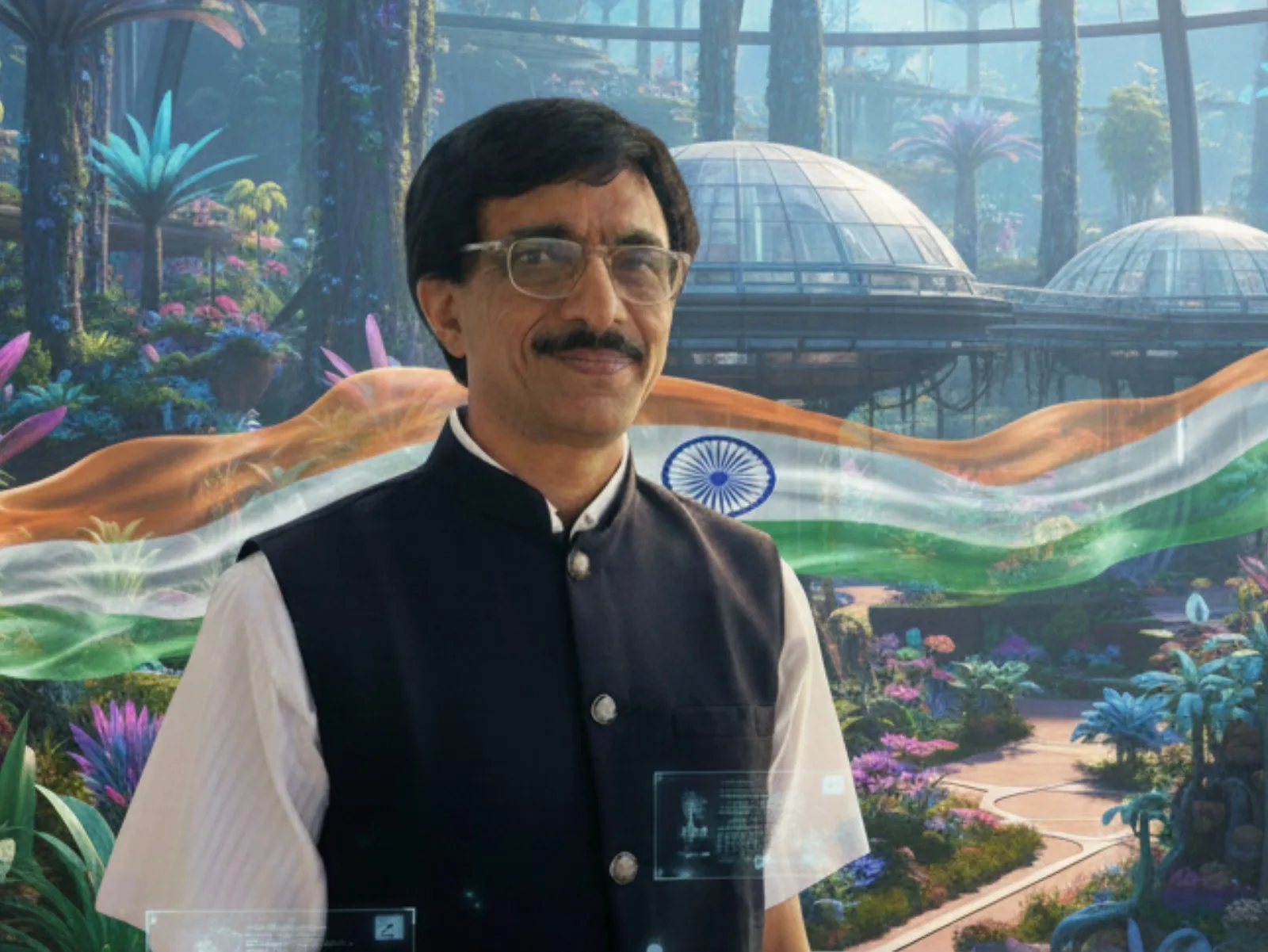
Have you ever met someone who seemed to hold two worlds in perfect balance? Someone who could speak the language of rockets and equations, yet also the quiet truth of temples and faith?
Most of us spend our lives trying to make sense of contradictions — science or spirituality, logic or belief, ambition or peace. We’re told we must choose. But what if you didn’t have to?
Dr S. V. Sharma never chose between them. He became both.
“I am zero,” he says softly. “And I am infinite.”
It sounds like poetry until you realise it’s the formula he has lived by — a philosophy that powered India’s journeys to the Moon, the Sun and Mars, and a belief that shaped one of the most extraordinary minds of our time.
Born in a small town near the sacred Hasanamba Temple in Hassan, Karnataka, he grew up watching lamps that burned for a year without going out. The young boy who once stood in awe before those flames would grow into a scientist who lit a different kind of lamp — one that illuminated India’s place among the stars.
In 2013, as Programme Director and Programme-Planning Director at ISRO, he stood before a room full of sceptics and declared:
“Twelve months from now, we are going to Mars.”
Exactly a year later, the Mars Orbiter Mission (MOM) lifted off — and succeeded on its very first attempt. Yet Dr Sharma speaks not of pride, but of Dharma — the quiet law that governs all things, from fire and water to the human heart.
Because when you understand your place in the cosmos — both zero and infinite — there is nothing you cannot do.
Zero and Infinite — The Man Who Became Both
“I am zero. And I am infinite.”
When Dr Sharma says these words, he doesn’t speak like a scientist explaining an equation — he speaks like someone who has lived its truth.
Zero and infinity — the two extremes of existence. In mathematics, they are opposites. In his eyes, they are one and the same.
“Anything you multiply by zero becomes zero,” he explains. “Anything divided by zero becomes infinite.” He pauses, smiling slightly. “That is my life.”
To most people, these are numbers — abstract and distant. To Dr Sharma, they are metaphors for being. Zero is humility: the acceptance that you own nothing. Infinite is potential: the boundless possibility that comes when ego disappears.
It’s what allowed him to stand in rooms where others hesitated and declare impossible missions possible. It’s what helped him see that the same force guiding rockets into orbit also keeps a temple lamp burning for a year.
In a world that demands we choose between faith and logic, Dr Sharma chose both — not out of confusion, but out of clarity. To be “zero” is not insignificance; it is being empty enough to receive everything. To be “infinite” is not pride; it is recognising that life, science, and spirit are boundless when you stop drawing lines between them.
That simple yet profound idea — zero and infinite — is more than philosophy. It is the equation behind his life, his work, and his way of seeing the universe.
The Boy Who Witnessed Miracles
Before the scientist, there was a boy — standing barefoot on the cool stone floor of Hasanamba Temple, watching two oil lamps flicker in the dim light. Those lamps would burn, untouched, for an entire year.
Every year the temple opened for only eight to ten days. His father, one of the priests, performed the rituals — decorating the goddess, offering food, and lighting two lamps with three and a half litres of oil. Then the doors were sealed for 365 days. No one entered.
And yet, when the doors reopened, the miracle repeated: the offerings untouched, the flowers still fresh, the lamps still glowing.
“What do you call it?” he asks with a quiet smile. “A miracle? A mystery? Maybe both.”
As a child he didn’t have the language of physics to explain it, but he didn’t need to. What he felt was wonder — the kind that lives at the edge of reason. That temple became his first laboratory.
“When the temple closed,” he recalls, “I felt like something in me had gone missing — I was zero without Devi. When it opened again, I felt the whole cosmos within me — infinite bliss filled my heart.”
It is a rhythm he carried through life — the movement between emptiness and fullness, loss and renewal. Later, when he spoke of rockets, orbits, and lunar missions, that same wonder returned — not in prayer, but in precision.
“Where science ends,” he says, “spirituality begins.”
And perhaps it all began with those two lamps — still burning in the temple of a young boy’s heart.
Lessons Beneath an Open Sky
Before he studied the stars, he studied under the sky.
Dr Sharma grew up in Kandali, a small village near Hassan. His government school stood almost roofless; lessons were held beneath a vast banyan tree. Some days the Yagachi River flooded and the teacher never arrived; on others, rain simply ended the day. There were no labs, no projectors — but there was curiosity, and that was enough.
“I studied in a village where there was no roof,” he says. “Sometimes, if it rained, there was no class. If the teacher could reach the school, we learned. If not, we waited.”
In that rhythm of sometimes yes, sometimes no, he began to see something profound.
“That is life,” he would later say. “Yes and no — that is the cosmos.”
It was there, among mud floors and chalk-stained palms, that his sharp mind began to take shape. Once, during a physics class, he calmly told his teacher, “Whatever you’ve done is wrong — we’re only fooling the students.”
Angered, the teacher struck him and ordered him to teach the class himself. The boy, trembling yet bold, walked to the board and explained atomic theory and the periodic table for forty-five minutes. His clarity stunned everyone. From that day, the teacher regarded him with lifelong respect.
Decades later, after the Mars Orbiter Mission, that same teacher phoned him:
“I am proud of you, my boy. God bless you.”
It was the last call before the teacher passed away — a moment Dr Sharma still calls his greatest honour.
“What everyone could solve, I didn’t touch. What no one could solve, I finished,” he says. That defiance wasn’t rebellion; it was vision. And it was this restless, questioning mind that would soon meet a man who changed his life — Dr A. P. J. Abdul Kalam.
Meeting Dr Kalam — The Spark That Ignited a Dream
Some encounters change your life. Others change the direction of a nation. For Dr S. V. Sharma, meeting Dr A. P. J. Abdul Kalam did both.
He was still in school — perhaps in the tenth or eleventh standard — when their paths crossed in Rameswaram in 1978. Dr Kalam was already a respected scientist; Dr Sharma, a young, fiery student from a small village who didn’t fit anyone’s definition of normal.
“I met him in Rameswaram when I was not even an undergraduate,” he recalls. “From that day, I was groomed and blessed by him.”
It wasn’t just a meeting of minds — it was a meeting of spirits. Both men believed in dreaming beyond the visible horizon, in asking why not when the world said impossible.
They spent days together in Rameswaram — visiting temple, mosque and church with equal reverence. Kalam, born to a Muslim family, grew up beside the temple and studied in a Christian school. Sharma, born Hindu, was mentored by Kalam and educated in a missionary school.
“Knowledge has no boundary,” Dr Sharma says. “We must unite every citizen of this world for one great cause — humanity.”
Their friendship transcended religion, language, and status. He became part of Kalam’s family — “for every occasion in his house, I was a permanent invitee.”
He still laughs when he remembers their early years, living under heaps of papers in a tiny room at Trivandrum railway station, eating simple canteen meals with other ISRO scientists. “Golden days — are they not?” he says, eyes shining.
Once he told Kalam, “One day, every citizen in this country will look up and say, ‘Yes, I have done it.’” Kalam laughed. “You’re mad,” he said. Sharma smiled. “Yes, I am mad — and I’m happy about it.” That madness became his compass.
After graduation, Dr Sharma joined ISRO as a young engineer and learnt rocket science step by step. He worked directly under Prof U. R. Rao, India’s celebrated “Satellite Man”. “The toughness of Professor Rao on technical matters,” he recalls, “and his humanity in personal matters — unbelievable. He was a friend, philosopher, and guide.”
Those lessons of rigour and compassion stayed with him for life.
To the Moon, to Mars, to Sun and Beyond
By the time India turned its gaze to the Moon, Dr Sharma was already looking beyond it. From a curious village boy he had grown into one of India’s most trusted space technologists — calm, precise, and quietly fearless.
“In meetings,” he smiles, “my silence was a mystery to many. But when I spoke, everyone listened — because I always went prepared.”
In 2008, as part of Chandrayaan-1, he led the components team that helped India make global history — discovering water on the Moon for the first time. “Three decades before us, the United States had landed on the Moon, Russia had made several missions,” he says, “but we were the first to find water. Perhaps it’s because our sages had already taught us Chandamama cool cool.” He laughs softly.
Then came the challenge of Mars. In 2013, facing a room full of sceptical officials in Delhi, he rose and said,
“In twelve months from now, we are going to Mars.”
Exactly a year later, Mangalyaan, the Mars Orbiter Mission, launched successfully. Against every odd, India became the first Asian nation to reach Mars orbit — on its very first attempt.
Working with a budget of just ₹450 crore, Dr Sharma’s team completed the mission under budget at ₹400 crore — even returning ₹50 crore to the Government. “Bollywood films cost more,” he jokes. MOM travelled 55 lakh kilometres at 40,000 km per hour, reaching Mars in nine months — at a cost of only ₹8 per kilometre. “Even an auto-rickshaw can’t take you that cheap!” he laughs.
When asked how he managed it, his reply is simple:
“I have nothing to lose and nothing to gain. Life goes as it goes. We must attempt impossibilities with grit and conviction.”
That calm, detached confidence — rooted in purpose, not pride — set him apart. He wasn’t chasing glory; he was fulfilling Dharma.
In 2012, designated as Group Director Program Planning and Evaluation Group PPEG, Group Director Computer and Information Group, Controller & vigilance Commissioner and in 2024 additionally designated as Deputy Director Satellite hardware production and Program Director for Human Resources and Academia carried out several responsibilities at a time and took responsibility for leading the organisation from the front. He was responsible for realising all hardware for Chandrayaan-3.
After a decade of painstaking design and testing, he watched the Vikram Lander touch down safely on 23 August 2024 at 6:04 p.m. IST, as Prajna Rover rolled out on the Moon’s surface. “One moon day — fourteen earth days — of perfect success,” he says, pride glinting beneath humility.
And barely a week later, on 2 September 2024, Aditya-L1, India’s first mission to the Sun, lifted off flawlessly.
“These two launches back-to-back tested the limits of every scientist,” he admits, then laughs. “But that’s life — it goes on and on.”
Aditya, he explains, will study solar radiation, coronal mass ejections, and the fierce environment that satellites must survive. “Twelve years of effort,” he says, “but the first images made it all worthwhile. It’s like the pain of delivery — once you see the child, the pain vanishes.”
Where Science Ends, Spirituality Begins
For Dr Sharma, the universe was never divided into two halves — the seen and the unseen, the measurable and the mystical. To him, they are one seamless whole.
“The universe itself is built on zero and infinity,” he explains. “Sixty-nine per cent dark energy, twenty-six per cent black holes, only five per cent matter that we can feel.”
“There is no question of discounting one or the other,” he says. “Where science ends, spirituality begins.”
It isn’t a rejection of science — it’s an acknowledgment of its limits. Science measures what can be known. Spirituality feels what can’t yet be measured. One begins where the other humbly bows.
Every mission, he says, was also a meditation — an act of faith in human potential. Behind every orbit, every equation, he sensed an invisible order, a rhythm, a Dharma.
Faith, to him, was never blind. It was a form of clarity — another way of seeing. Science and spirituality were not opponents in his world; they were two languages of the same truth — one spoken through discovery, the other through devotion.
He could look at the stars with a scientist’s eye and a saint’s heart — and find no contradiction in doing both.
The Dharma of All Things
When Dr Sharma speaks about life, his voice carries the calm of someone who has seen both the complexity of science and the simplicity of truth. Sometimes he pauses so long that the silence itself feels sacred.
“Everything,” he says, “has a Dharma.”
It’s not a religious statement — it’s an observation of nature itself. To him, Dharma is the fundamental law of existence, the quiet order that keeps everything in balance.
“We are governed by the Pancha Bhoota — earth, water, fire, air, and space,” he explains. “Fire will always be fire; it will never be cold. That is its Dharma. Water will always flow. Air will always move — and we can breathe only air, not fire or water. Space will always hold everything, infinite and silent. Earth is always rigid and finite. Each element follows its nature — and that is Dharma.”
He lets the thought settle before adding, “So should we.”
To him, Dharma isn’t a rule; it’s a rhythm — living in alignment with what you are meant to be. An elephant eats grass; a lion hunts. Neither tries to be the other. That, he says, is the secret harmony of life.
But when humans forget their Dharma — when we harm more than we heal, take more than we give — imbalance begins. “When we realise we are here to give to nature rather than take from it,” he says, “then human Dharma prevails.”
His teaching is simple: live and let live.
That, he believes, is the Dharma of being human — the same principle that guided his work at ISRO. Progress must serve life, not overpower it. Every launch, every discovery, was not about dominance over the cosmos but partnership with it.
For Dr Sharma, Dharma isn’t confined to temples or scriptures. It lives in every act of integrity, every moment of compassion, every decision that brings balance instead of chaos. When you live by Dharma, he believes, you move with the same law that keeps the stars in orbit — and the lamps burning in Hasanamba Temple.
What Next
For Dr Sharma, discovery has never meant a destination — only another beginning. “Space activity,” he says, “should not be limited only to the government.”
He believes India’s newfound enthusiasm will inspire students, entrepreneurs and start-ups to create technologies that serve the world. The next chapter of India’s space story, he says, must belong to everyone.
His eyes brighten when he speaks of the Gaganyaan mission — India’s first manned flight to space. “One day, common citizens of this country must travel to space,” he says, smiling. “Why not? Space tourism, moon colonies, Mars landings, the study of Venus — where is the limit? Where do you stop? Life goes on and on.”
That laughter — equal parts scientist and sage — holds within it the same spirit that carried him from a roofless school to the edge of the solar system.
Zero and Infinite — The Legacy
At the end of it all — the rockets, the missions, the applause — Dr S. V. Sharma still returns to the two words that shaped his life: zero and infinite.
In a world obsessed with becoming something, he reminds us of the quiet strength of becoming nothing. When you accept that you are zero — empty of ego, open to learning — you become infinite in what you can achieve.
That is his legacy.
It lives not only in the data streaming from the Moon or the images of the Sun, but in the courage to dream, the faith to act, and the humility to keep learning.
He showed that a scientist can also be a seeker. That equations and prayers can belong on the same page. That science, at its best, is not a fight against mystery — it is a form of worship.
“Whatever you do,” he says, “do it ritually. Then there is no strain. Sincere effort must be ours; the results are eternal. The fruit is always assured.”
His story isn’t only about reaching other worlds; it’s about discovering your own — the one where reason and reverence coexist, where Dharma gives direction to ambition, and where greatness means not rising above others but rising beyond yourself.
He has lived as zero and infinite — the perfect balance of nothingness and everything. And in doing so, he teaches a simple truth:
You don’t have to choose between science and spirit, humility and power, earth and sky. You can be both.
Because the universe itself is built on that truth — from zero to infinite, and everything in between.
Closing Reflection
Dr S. Venkateswara Sharma — affectionately known as Dr S. V. Sharma — is one of India’s most accomplished space technologists. As Deputy Director and Programme Director at ISRO, he has been part of more than a hundred rocket launches and the realisation of hardware for over 120 satellites. As strategist and visionary, he helped shape the organisation’s modern direction.
Yet, despite all this, he remains humble and unassuming — a scientist guided by spirituality, a leader guided by Dharma.
His life is proof that technical brilliance and inner balance are not opposites; they are partners. He has shown that progress without purpose is hollow, and faith without action incomplete.
True greatness, he reminds us, is never loud. It is luminous. To live as he does — with the clarity of zero and the courage of infinity — is to understand what it truly means to be human.
By Ugesh Sarcar