Wisdom Bank - The Childhood Dream That Became a Lifelong Mission — Dr. Sharan Srinivasan’s Story
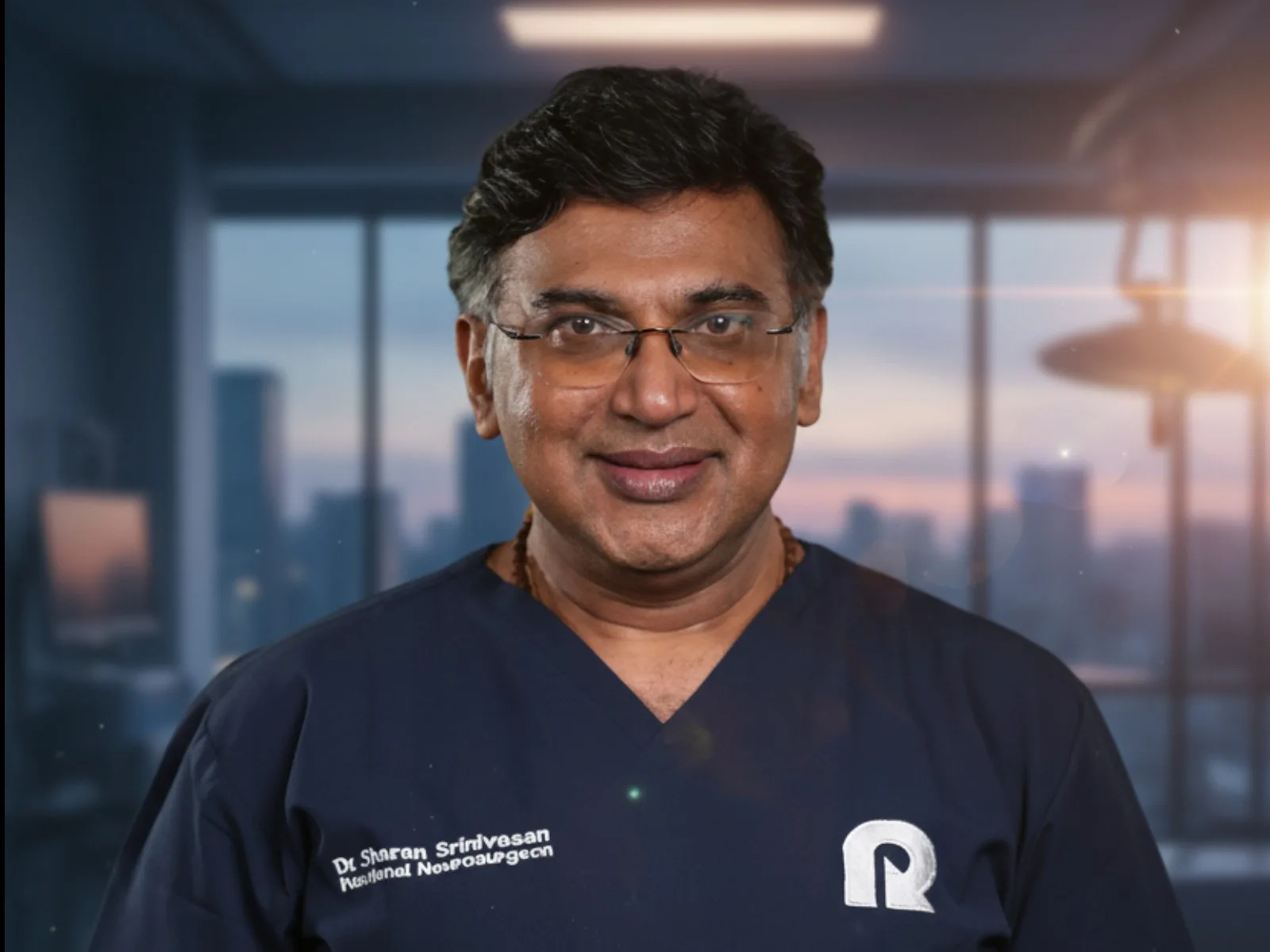
When Dr. Sharan Srinivasan was in school, he had a problem: his shoes had to be polished every day for inspection, and he hated wasting time on it. So he came up with a workaround. He’d polish only the outer side of each shoe — the side the PT master would see — and angle his feet just right during inspection.
To him, it wasn’t about laziness. It was about efficiency. “Why polish the part that’ll be dirty in ten minutes anyway?” he shrugged.
That same sharp, mischievous logic has followed him into the operating room, where he now performs life-saving brain and spine surgeries. But here’s what’s unusual: while most high-skilled neurosurgeons are drawn to the prestige, money, or international careers that come with the job, Dr. Sharan made a different choice. He chose service.
He stayed in India. He works in a charitable hospital. He runs a world-class neuro-rehabilitation centre for poor patients. He performs high-risk surgeries for those who can’t afford private care. And he does it all without compromising his principles — or his humour.
In this article, you’re not going to read a puff piece about a “hero doctor.” You’re going to walk alongside a man who dreamt of neurosurgery at 13, chased that dream for 18 years, and built his life around three things: integrity, impact, and an unshakeable love for what he does.
You’ll hear stories that move you. Stories that make you laugh. Stories that might just reframe how you think about honesty, purpose, and the quiet power of doing the right thing — even when no one’s watching.
Let’s start at the beginning.
The Seed of a Dream
It started with a magazine.
Long before YouTube tutorials or Google search bars, a young boy in 8th standard sat cross-legged with a copy of Reader’s Digest in his lap. His mother had a subscription, and he devoured each issue the moment it arrived. But he never read it front to back — he had a system.
He’d flip straight to a section called "Drama in Real Life." That month, the story was about a woman skiing down the Alps who suddenly collapsed with a brain haemorrhage. A helicopter swooped in. She was rushed to a hospital. Doctors diagnosed an aneurysm. Neurosurgeons operated. She survived.
To a kid growing up in India in the 1980s, this felt like science fiction. Medicine that could pull someone back from the edge of death? It was thrilling. It was powerful. And it planted a question in his mind that would never leave: “What if I could do that for someone?”
That same magazine issue featured a profile of a Canadian neurosurgeon operating on children with brain tumours. He spoke not just of surgery, but of holding space for families — for parents, for grandparents — and navigating their pain with honesty.
A third article in that same issue explored the human brain itself — the final frontier. So much unknown. So much yet to be explored.
For Sharan, who’d always hated textbook answers and static knowledge, the brain felt like the perfect mystery. “I loved exploring things until I was convinced,” he recalled. Neurosurgery wasn’t just science — it was discovery.
He made the decision in 1984. He earned his neurosurgery degree in 2000 — chasing that dream for nearly two decades.
Rooted in Integrity
Ask Dr. Sharan Srinivasan the one value that defines him, and he doesn’t hesitate: integrity.
But this wasn’t something he read in a book or picked up in medical school. It came from his grandfather — a man he describes with reverence, who left an imprint deep enough to outlive his short time with him.
“If wealth is lost, nothing is lost. If health is lost, something is lost. But if character is lost, everything is lost.”
That was his grandfather’s mantra. He said it so often, it became background music in the house — words woven into the wallpaper of Sharan’s childhood. He was a senior chartered accountant with a deep sense of ethics, and as a young boy, Sharan would sit with him and ask big questions, like what corruption meant.
His grandfather's answer was practical, not preachy:
“If you give someone money to do what they should already be doing, that’s like a tip. But if you pay money to get something illegal done — that’s corruption.”
It was black and white. Clear, not moralistic. And that clarity stuck.
Years later, when Sharan became a doctor, those lessons weren’t just values — they became practice.
Because in neurosurgery, there’s no room for lies.
If a patient is dying, you have to say it. If the surgery carries a risk of death, you have to declare it. And if a life can be saved, you have to be willing to take that risk — honestly, transparently, and without sugarcoating.
But here’s the magic: he doesn’t sugarcoat the truth — he reframes it.
Like the time a friend named Rajeshwari called him, sobbing after a cancer diagnosis. She wasn’t even his patient — he’s a neurosurgeon, not an oncologist. But she wanted to see him because she trusted him.
He didn’t tell her not to worry. He didn’t pretend it would be easy. Instead, he moved her from “Why me?” to “What next?”
When she cried about losing her hair to chemo, he told her to go to Tirupati and donate it before it fell — “at least then it’s your choice,” he said, adding a touch of humour to the pain.
She laughed. She fought. She healed.
More than a decade later, she still calls him to say thank you — not for a cure, but for honesty delivered with compassion.
“All I did,” he says, “was tell the truth differently.”
That — more than anything — is what defines his integrity. Not brutal honesty. Not soft lies. But a kind of truth-telling that leaves people stronger than he found them.
Medicine With a Mission
Dr. Sharan didn’t become a doctor because he had all the answers. In fact, when he first decided on neurosurgery in the 80s, he barely knew what it was.
There was no Google. No YouTube. No documentaries or explainers. Just a sense — sparked by stories — that this was the kind of work that mattered. That if he could help someone walk again, talk again, live again, that would be a life worth living.
But as he stepped into medicine, the abstract dream became real. He saw young people — just married, full of promise — come in with head injuries and never go home the same. He saw patients survive strokes, only to lie in beds for months, semi-conscious, their families circling between hope and heartbreak.
And through all of it, he noticed one thing: they looked at him with trust. Not because he had all the answers, but because he showed up.
“I was the baby doctor,” he says, half-laughing. “But I was the one they saw every day, the one they stayed with for weeks or months.”
In those moments, medicine stopped being a career. It became a commitment — to showing up when it mattered most. To sitting with suffering. To being the one who didn’t walk away when things got hard.
That commitment wasn’t just emotional — it was structural.
Both he and his wife earned their medical degrees at a government college — MBBS for just ₹5,000. His neurosurgery degree? ₹75,000. In a world where private medical education now runs into crores, their path was possible because the public had paid for it. Not family wealth. Not privilege. But millions of strangers — taxpayers — who would never know their names.
“We were educated by the people,” he says. “So how could we not serve them in return?”
It was never a question of ‘should we give back?’ It was obvious. We owed them. That’s it.
So when the offers came — the promise of a career abroad, the lure of corporate hospitals, the comfort of higher pay — he walked the other way.
“We stayed,” he says simply. “Because the hands that built us were the hands of ordinary people — and we wanted those hands to be the ones we served.”
The Power of Truth
For most doctors, telling the truth is part of the job.
For Dr. Sharan Srinivasan, it’s the heart of the job.
Not the cold, clinical kind of truth — the kind that leaves families shattered and helpless. But the kind that empowers, even in the darkest moments.
“If a patient is dying, I have to say it. If the surgery might fail, I have to say that too. There’s no way to push the pain aside — but I can carry it differently.”
That’s where his real skill lies — not just in the hands that perform high-stakes brain surgeries, but in the words he chooses before and after. He doesn’t soften reality. He reframes it — with clarity, compassion, and confidence.
It matters most during emergency procedures. In neurosurgery, he often deals with patients who are unconscious, critical, and racing against time. The family has minutes to decide — operate or not. The stakes? Life, death, or permanent disability.
In those moments, many hospitals hand over the consent conversation to a junior doctor, who blurts it out as fast as possible:
“There’s a high chance the patient may die. Please sign here.”
To families in crisis, this isn’t just overwhelming — it’s paralysing. The person they love is barely holding on, and now they’re being told they might not make it through surgery. Many back out, terrified of making the wrong call.
Dr. Sharan takes a different approach.
He gives them the truth, but he gives it structure.
“Yes, there is risk,” he says. “There is a chance your loved one may not survive the operation. But I want you to know three things before you decide.”
One: “I’ve done over 1,500 high-risk brain surgeries. Only two patients have died on the table.”
Two: “Many of those patients went back to work, back to life.”
Three: “Just because you’ve given me a death-on-table consent doesn’t mean I’ll do a bad job. I will fight for them like they’re my own.”
The tone is calm. The facts are transparent. And the intention is clear: to replace panic with presence.
“When I finish talking,” he says, “most families say: ‘Sir, God is with you. Please go ahead.’”
Because he’s not asking them to sign a form — he’s asking them to believe in a possibility. He gives them what most of us need in moments of crisis: a hand to hold and a path to walk.
And he does it all without lying. Just by telling the truth in a way that leaves room for courage.
Focus, Clarity, Mischief
For someone so serious about saving lives, Dr. Sharan Srinivasan has always had a mischievous streak. And not the mild kind.
He describes himself as a “terrible child” — not in a self-deprecating way, but with the grin of someone who’s always had too much energy and a mind that worked just a little too fast.
“I used to get caned every other day,” he laughs. “So I started writing impositions in advance.”
While his classmates copied notes, Sharan would scribble out lines like “I will polish my shoes,” or “I will do my homework,” and stockpile them for future punishments. That way, when the inevitable happened, he could hand in the work and still make it to the playground.
But he wasn’t a slacker — far from it. What looked like mischief was actually strategy. He just didn’t like wasting time on rules that didn’t add value.
He calls himself lazy. The truth? He was efficient. Always finding the smartest way to do the minimum for the maximum result — not because he didn’t care, but because he had his eye on something bigger.
That focus followed him through medical school.
While most of his peers applied to 10 or 12 post-graduate entrance exams, Sharan applied to just one — the one he wanted.
“People thought I was crazy. They’d ask, ‘What if you don’t get in?’ I said, ‘Then I’ll try again next year. I know what I want. Why waste time on what I don’t?’”
This wasn’t arrogance. It was clarity. In a world full of noise and distractions, he had learned — early — to tune in to what truly mattered. And once he locked onto it, he chased it with everything he had.
Even today, that same mischievous energy shows up in his hospital rounds. He sits on patients’ beds. Ruffles their hair. Cracks jokes. Plays the fool. Because in his world, healing doesn’t just come from scalpels and scans — it comes from connection.
“People say I’m always at a 9 or 10 on the energy meter — even at 2AM. But I’m not tired, because I’m not pretending. This is who I am.”
The Bigger Picture
For Dr. Sharan Srinivasan, neurosurgery isn’t the finish line — it’s the launchpad.
Because saving one life is powerful. But changing the system that denies care to millions? That’s purpose.
He doesn’t romanticise it. He sees the reality every day — patients who come in too late because they can’t afford the scans, the surgeries, the aftercare. Families choosing between treatment and survival. Hope rationed out like a luxury.
“I didn’t just want to do good surgeries,” he says. “I wanted to ask — how can we make this care reachable?”
That question became a mission. And that mission became PRS Neurosciences — a centre he co-founded to offer world-class neurorehabilitation for patients recovering from strokes, spinal cord injuries, head trauma and more. The focus? High-quality care, at costs people can actually afford.
He didn’t stop there.
Alongside his wife, he co-runs an NGO that provides free surgeries for poor patients, often covering the most complex neurological procedures. They find ways to bridge the gap between skill and access, one case at a time.
He also travelled to Japan to learn low-cost surgical techniques — not to add another feather in his cap, but to make advanced treatments for patitents suffering from diseases like Parkinsons, Dystonia, Tremors, Spasticiy and Pain using techniques like Radio Frequency Ablation (RFA) instead of expensive treatments like the Deep Brain Stimulation.
His simplification of this:
“Burning misbehaving brain circuits”.
This isn’t charity. This is justice. It’s not about being the hero. It’s about honouring the people who gave him the chance to be here in the first place.
“Everything I’ve built, I’ve built with one question in mind — how do we democratise healthcare in this country?”
He’s not interested in flashy breakthroughs or international accolades. His eyes are set on impact — real, measurable, everyday change in the lives of people who have no one else fighting for them.
And the truth is — he’s not done. Not even close.
Final Reflection: What Will You Choose to Build?
Dr. Sharan Srinivasan didn’t get here by accident.
He wasn’t the most obedient student. He didn’t chase the safest path. And he didn’t follow the crowd. What he did do — relentlessly — was hold on to a vision he had at 13 and refuse to let it go.
He didn’t become a neurosurgeon for status. He didn’t stay in India because he lacked options. He didn’t build low-cost healthcare systems because it was easy.
He did all of it because it was right.
Because he believed — and still believes — that the purpose of knowledge is to serve. That integrity is a daily practice, not a personality trait. That even in life-or-death moments, truth delivered with care can be a form of healing.
“I’m not doing this as a profession,” he says. “I’m doing it because I’m still in love with what I do.”
And that love shows up in every patient he fights for. In every family he comforts. In every system he challenges, and every wall he breaks down.
This isn’t just the story of a gifted neurosurgeon. It’s the story of someone who made deliberate choices — and built a life around purpose, not just profession.
So maybe the question this story leaves you with isn’t “How did he do it?” It’s this:
What do you care enough about to build — even when no one’s watching?
By Ugesh Sarcar