Wisdom Bank - The Turnaround: How Aslesha Madappa Built Business from the Outside In
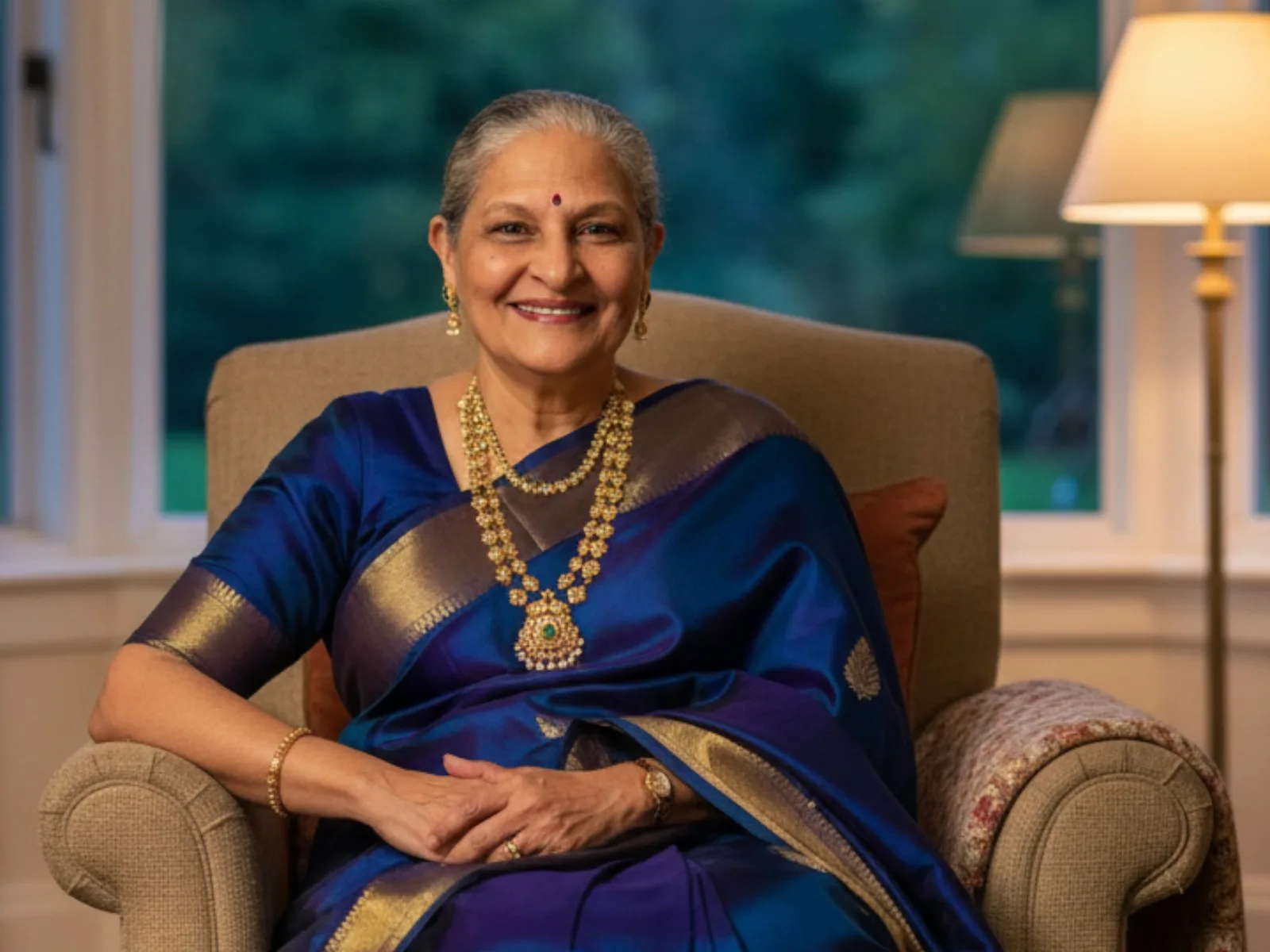
The boardroom reeked of old money and older egos. Each month, members of the Chamber of Commerce’s Managing Committee gathered around a heavy teak table — industrialists, exporters, legacy business families. All men. All regulars.
Except her.
Aslesha Madappa sat tall at the far end — the only woman in the room, the only one without an empire to her name, and possibly the only one still learning what “EBITDA” meant.
That day, just before a foreign ambassador was due to arrive, a senior textile baron — owner of a vast empire — leaned back, crossed his arms, and with a smile dripping in patronage, said:
“So, Aslesha… what’s your turnover?”
The room fell quiet. Even the journalists on the outer ring stopped rustling their notes.
Aslesha didn’t answer right away.
Instead, she slowly swivelled her chair in a full, deliberate circle. One complete turn.
Everyone stared. She came back to face him, smiled and said:
“This.” “That’s my turnaround.”
Laughter cracked across the table. Even the man who’d asked couldn’t help but grin.
Then she added, warm but pointed: “That’s better. Because I didn’t ask you.” And with calm finality: “I’m in the green. And as long as that happens, I’m good.”
It was cheeky. It was powerful. And it was entirely her.
No inflated numbers. No apologies. No playing small. Just wit, presence, and the kind of confidence that’s forged — not gifted.
That moment wasn’t just a clapback. It was a metaphor. For how she’d enter a world that never expected her, turn it on its head, and build something entirely her own.
Because nothing in her upbringing had prepared her for business. She was a bureaucrat’s daughter. Raised in Delhi’s corridors of power, where ambition wore a government badge and “entrepreneurship” sounded like a risk no respectable family would take. Her father, a senior government official, wouldn’t even allow Diwali sweets from businessmen into their home.
She had no training. No pedigree. No plans.
But life had other ideas.
Thrown into the deep end after marriage — with no resources, no experience, and two small children — Aslesha didn’t just figure business out. She redefined it — quietly, boldly, and on her own terms as a first-generation woman entrepreneur.
She built a company. She helped pioneer India’s first entrepreneurship development programme for women. She helped rural women in Karnataka turn oranges, coffee, honey, and cardamom into micro-enterprises. She fought wars — some with markets, some with people, some with herself.
This is her story.
A story of detours, disasters, comebacks, and reinvention. Not the kind you scroll past on LinkedIn. The kind you feel in your gut. The kind that reminds you it’s not too late. That you don’t need the perfect plan, the perfect partner, or the perfect pitch deck.
You just need to begin. And if you must — do a full turnaround.
The Unexpected Entrepreneur
She wasn’t supposed to be here.
If you had met Aslesha Madappa in her twenties — fresh out of Lady Shri Ram College, surrounded by power, policy, and protocol — you’d never guess she’d one day run a business, let alone help thousands of others start theirs.
She was a bureaucrat’s daughter. In her world, “business” wasn’t just unfamiliar — it was disreputable. Her father was one of the highest-ranking civil servants in the country. Defence Secretary. Planning Commission Secretary. Her home in Delhi was steeped in integrity, hierarchy, and caution. And in that home, businessmen weren’t just kept out — they were viewed with deep suspicion.
“Back then, I genuinely believed all businessmen were thugs,” she laughs now — a mindset shaped by the world she came from, not the one she would grow into.
Then came the arranged marriage. At 19, she married a man 14 years her senior — a kind, ambitious soul with entrepreneurial dreams. She left Delhi, left her comfort zone, and followed him south. With no plan beyond being a supportive wife and hands-on mother.
But fate doesn’t follow plans.
Her husband began exploring a small agri-business venture. But the government kept calling him back into service. The business needed someone to step in. And he turned to her.
“You’re capable,” he said. “Just do it. I’m here.”
And so she did.
With no experience. No roadmap. No language for this world.
She was terrified.
She’d always associated business with risk, manipulation, and murky dealings. It felt alien. But there was no time to hesitate. So she walked in — quietly, unsure, but all in.
What no one saw — perhaps not even she — was that beneath the doubt was discipline. She had been trained to perform. To excel. To give everything 110%, because mediocrity had never been an option. As the only daughter, only niece, only granddaughter, the spotlight had always been on her for several formative years.
So she brought that same intensity to a space she didn’t yet understand.
She learned furiously. She read. She asked. She travelled. She listened. She sought.
And over time, she began to see something others missed: Business wasn’t a scam. It was an opportunity. Not just for her — but for women everywhere who were told they couldn’t, or shouldn’t.
She didn’t just run a business. She began planting the seeds of something much larger.
She had no business becoming a businesswoman.
And yet, somehow, she did.
Learning Out Loud
There were no mentors. No handbooks. No weekend crash courses. If Aslesha wanted to learn how to run a business, she would have to do it the hard way — in public.
She showed up. Not pretending to know, but determined to understand.
She assimilated information. She travelled. She met manufacturers. She learned how to export in the age of telex and handwritten trade letters. She gathered knowledge wherever she could find it — from chambers, from customers, from competitors.
She walked into boardrooms that weren’t built for her, and earned her place not with force, but with quiet, consistent value.
At the Chamber of Commerce, she didn’t just attend. She listened. Then she spoke. Then she chaired committees — on HR, trade, entrepreneurship. Slowly, she built a reputation — not just as a woman in business, but as someone who brought results.
Beyond boardrooms, she rolled up her sleeves.
One of her earliest suppliers operated out of what she called a “dirty hole in the wall.” But instead of walking away, she and her husband invested time and trust. Decades later, that same supplier runs a high-standard facility — and remains a partner to this day, thanks to Madappa's sweat equity and free consultancy.
She didn’t learn in silence. She learned out loud — and in doing so, showed others that you don’t need to know everything to begin.
From One Woman to Many
As her own business took shape, she saw the larger gap: women like her — capable and willing — who had no access, no guidance, and no support.
So when AWAKE (Association of Women Entrepreneurs of Karnataka) began forming in the early 1980s, she joined as an early member and lifelong contributor.
She helped design and deliver AWAKE’s first-ever Entrepreneurship Development Programme for women — a six-week training course sponsored by IDBI Bank. It became the first of its kind in India.
But she didn’t stop at curriculum. She helped take the programme to the villages, translating modules into Kannada, speaking at Rotary clubs and colleges, and inspiring rural women to see entrepreneurship in the everyday.
“Why not turn your family land into a homestay?” she’d ask. “Why not bottle the pickles and jams you already make?” "Why not use natural and local resources?"
She brought in scientists from CFTRI. She helped AWAKE build a food processing incubator. She taught women how to write business letters, explore exports, understand pricing.
AWAKE wasn’t just an organisation. It became a spark — one that lit up futures across Karnataka.
And Aslesha helped light that spark by doing what no one had done for her — showing up with structure, not speeches. She walked the talk — to motivate and to model: if she can, I can.
The Cost of Standing Straight
Success came, but it wasn’t handed to her. And it never came without cost.
Her team had shipped a pharmaceutical consignment to Africa, with payment supposedly secured through a cheque. The bank — confident in her company’s reputation — released the funds in good faith. The cheque bounced.
The client vanished. The payment was fake. And the bank manager who’d cleared it was now facing the threat of suspension.
Aslesha could have walked away. The fraud wasn’t her fault. But that wasn’t the question. The question was: What kind of business did she want to run?
So she and her husband made a quiet, personal decision: They sold their land near RT Nagar and repaid the bank — down to the last rupee.
No press release. No public display of sacrifice. Just a private act of integrity. And a message: we will not let someone else carry our burden.
It wasn’t the only time she paid a price for doing the right thing.
Her first ever export consignment — Tamarind Concentrate headed to the Gulf — returned mid‑sea due to reports of floating mines. The cargo, meticulously prepared and labelled in Arabic, became unsellable. She began her export career with a loss.
But she didn’t bend. Not when faced with failure. Not when faced with shortcuts. Because standing straight, for her, was the only way.
Grace Under Fire
In rooms full of noise, Aslesha Madappa made her mark with silence.
She wasn’t the one jostling for the mic. She didn’t carry business cards like ammunition. She didn’t dominate conversations. Instead, she observed. Measured. Chose her words with care.
But when she spoke, people listened.
Not immediately — and not always willingly. But over time, even the most seasoned power players learned something about her: she may have walked in quietly, but she never walked in unprepared.
Her presence — tall, poised, calm — often did the work before she opened her mouth. And when she did speak, it wasn’t with corporate jargon or curated confidence. It was with clarity. With data. With intention.
One moment stands out.
The Chamber of Commerce was hosting a foreign dignitary. The table was lined with top industrialists, but as usual, most of them had nothing to say beyond pleasantries. The president of the chamber, scanning the room in desperation for some engagement, turned to her.
“Ms. Madappa, anything from your side?”
She hadn’t planned to speak. But she always carried her product samples — a natural Tamarind Extract she exported widely in the Middle East.
She addressed the Ambassador of Afghanistan, offering a brief, precise introduction. Mentioned how widely the product was consumed in the region. Suggested a follow-up with the trade officer.
Simple. Elegant. Professional.
And yet, someone still couldn’t resist a patronising comment — a brush-off masked as a joke.
She didn’t take the bait. She didn’t need to.
Because in that room — full of unprepared, high-powered men — she was the only one adding value. And everyone knew it.
That was the pattern.
In another event, the Commerce Minister of India was visiting. The venue was packed. She took her seat in the second row, low-profile. She had no plans to speak or be seen.
Until the minister stepped off the dais, scanning the crowd — and walked straight toward her.
“Aslesha!” he said, lighting up. “How’s Madappa? How wonderful to see you. You must come home for dinner.”
They were former classmates. But that moment hit differently.
The whispers began immediately. The industrialists who had dismissed her earlier now wanted introductions. One of them leaned in later and said, half-joking, half-envious, “You could make crores with that kind of connection.”
She just smiled.
Because they saw a door-opening opportunity. But she saw a friend.
These weren’t moments of triumph in the traditional sense. They weren’t about titles or press coverage. They were about something rarer:
Being seen. Being remembered. Being respected — without ever having to shout.
That was her way. A quiet force. Unassuming, but undeniable.
A New Kind of Power
For decades, Aslesha Madappa lived by duty — to her family, her business, her community. But power, she discovered, doesn’t always look like influence or impact. Sometimes, it looks like a blank canvas, a cup of tea, and the freedom to create just for yourself.
That discovery began after a fall — literally.
In late 2023, she slipped from a kitchen counter while reaching for something, cracking her tailbone. The diagnosis: four months of bed rest. No meetings. No movement. No escape.
Most would have seen confinement. She saw a new space opening.
She ordered a small desk easel and paints. Set up a trolley with brushes and paper. And from her recovery bed, she began painting — quietly, joyfully, with no agenda. Guided by a Singapore-based artist offering free tutorials, she explored Indian folk art forms: Patta Chitra, Kalamkari, Gond.
What began as therapy became a me-space. A sanctuary.
No strategy. No outcomes. Just creation.
It was the kind of power she hadn’t known before — the power to do something simply because it brings you peace.
A Life Fully Claimed
There’s a kind of success that fills news columns. And then there’s the kind that builds quietly, breathes deeply, and changes lives without needing to be announced.
Aslesha Madappa chose the second.
She didn’t claw her way to the top. She lifted herself up — and brought others with her. She didn’t inherit power. She earned it, moment by unglamorous moment. She didn’t fight for attention. She fought for possibility — for herself, for the women who came after her, and for a kind of entrepreneurship rooted in ethics, not ego.
Her legacy isn’t built on scale. It’s built on integrity. On the kind of leadership that’s unshakeable because it’s un-bought.
She has stood in silence while others underestimated her. She has carried the weight of loss with grace. She has created opportunity where none existed. She has reinvented herself — again and again — without waiting for permission.
And today, in her 70s, she sits not at the end of a career, but in the centre of a life fully claimed. One that began with duty. Grew through grit. And now flourishes in joy.
This is not a success story. This is a masterclass in becoming.
Not of an entrepreneur. Not of a pioneer. But of a woman who turned everything that was supposed to hold her back into the very thing that carried her forward. One full circle. One quiet turnaround. And a life fully, unapologetically, her own.
Sometimes, the most powerful thing you can do — is turn around and begin.
By Ugesh Sarcar