Wisdom Bank - Abhijit Mahabal: The Zero That Opened a Thousand Doors
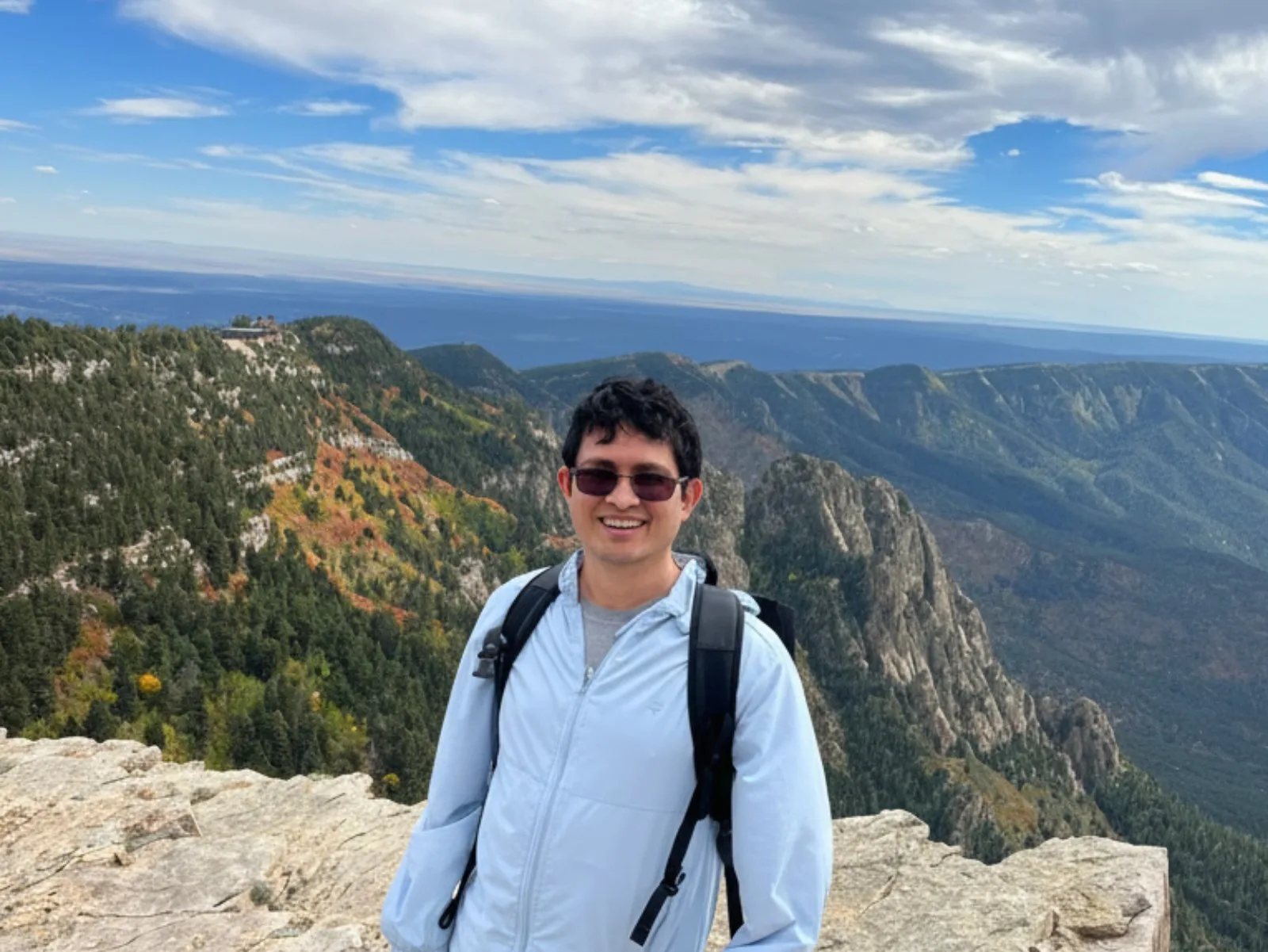
You wouldn’t expect a perfect zero to open a door — let alone many.
But for Abhijit Mahabal — now a Knowledge Architect at Pinterest, and formerly with Google Search, Google Research, and the Knowledge Graph — it did exactly that.
As a teenager, he represented India twice at the International Mathematical Olympiad. These were fiercely competitive selections — tests designed to separate the brilliant from the merely excellent. And Abhijit made the cut both times.
But what he remembers most? The perfect zero he scored in geometry. Twice.
He wasn’t bad at maths. The remaining 75% of the test — algebra, number theory, combinatorics — carried him through. But this one blind spot stuck with him like a pebble in a shoe.
And instead of shrugging it off, he began to wonder: Why?
“How could I be good at maths, yet completely miss out on geometry?” he asked himself. “What’s going on in the mind when it understands something — or doesn’t?”
That small internal glitch became a lifelong obsession. Not with geometry, but with thinking itself. With how knowledge forms. With how understanding works. With why our brains make the leaps they do — and why, sometimes, they don’t.
Before he ever touched a line of code or trained a machine to “understand” language, he was just a kid, stuck on a question that wouldn’t go away.
And he’s been pulling at that thread ever since.
The Compulsion to Understand: A Child with a Dictionary
In sixth grade, Abhijit moved to Rajasthan. His school was far, and all his friends lived closer to it — not near where he lived. Afternoons stretched long and quiet. There wasn’t much to do.
Most kids might have picked up a comic. Abhijit picked up an encyclopedic dictionary.
Not to look up a word. To read it.
From A to Z.
It wasn’t for homework or spelling bees. It wasn’t to impress anyone. There was simply a magnetic pull — a need to understand, to connect, to map meaning across everything.
“It might’ve been a form of OCD,” he says now, lightly. “But I had this need to know everything about everything.”
The encyclopedic dictionary became more than just a reference book. It was a galaxy of ideas. He didn’t just read definitions — he followed threads of logic, connections between concepts, the shape of how humans name the world.
There’s something deeply human about that — the quiet search for clarity in the noise. For some kids, it’s a friend. For others, a football. For Abhijit, it was a three-volume encyclopedic dictionary, page by page, entry by entry.
At home, he had an older brother — an astrophysicist in the making, who would later work at Caltech. “I think part of my interest in science came from watching him,” Abhijit says. “You know how younger siblings copy their older siblings?”
But this wasn’t just mimicry. This was instinct. It was the beginning of a mind shaped not by ambition, but by the hunger to see how things work — and more importantly, why.
A Career Built on Questions, Not Titles
Some people build their careers by climbing. Abhijit’s journey feels more like wandering through an endless library — following questions rather than job titles.
That dictionary-hungry kid grew into a college student still chasing the same spark: How do we think?
In the early days of AI — before it was fashionable — he found himself drawn to a writer whose ideas mirrored his own quiet scepticism. This researcher wasn’t interested in shiny demos or buzzwords. In fact, they deliberately gave their AI systems silly names like Copycat and Phaeaco, just to avoid the temptation of overselling.
“That honesty really resonated with me,” Abhijit says. “They didn’t pretend these systems were smarter than they were. They asked hard questions and didn’t decorate the answers.”
So Abhijit went to Indiana University to do a PhD under that mentor. Not because it was the obvious next step — but because the questions being asked there felt real.
After that came ten years at Google, where he worked on search, knowledge graphs, and language understanding. Then Pinterest, where he’s now spent over six years designing systems that help make sense of how users think and search.
But if you ask him about his career, he won’t list achievements. He won’t tell you about patents or papers or product launches.
“I just want someone to let me do what I’m doing,” he says. “I know they find value in it, and I enjoy it, that’s enough.”
That’s not resignation. That’s clarity.
Words, Meaning, and the Mess in Between
Abhijit has spent most of his professional life trying to teach machines to understand humans — or at least approximate it.
That means navigating ambiguity. Not the kind you fix with grammar rules, but the kind that shows up when one word can mean a dozen things, depending on context.
He recalls his first week at IIT Delhi. A senior on campus used the same slang word repeatedly — six times, six different tones, six completely different meanings. Each one understood instantly by everyone around.
“That stuck with me,” he says. “It showed me just how flexible — and complex — language really is.”
At Google, that complexity became his day job. If someone searched for “GM Coca-Cola”, they probably meant “General Manager”. But if they typed “GM Viswanathan Anand”, they meant “Grandmaster”. Same abbreviation, different intention.
“It’s not optional,” he says. “You have to solve for ambiguity in a search engine. Users don’t always know the precise term. They type fast, they make mistakes. But they still expect to get the right answer.”
His job was to help build systems that could figure out what people meant, not just what they typed. To take the uncertainty baked into human language and turn it into something a machine could act on — without flattening its nuance.
Even today, at Pinterest, he works on untangling the same knot. He builds systems that learn how users categorise ideas, make connections, and express themselves — often imprecisely.
Because real language — the kind we use every day — is messy. And if technology is going to understand us, it has to be able to sit with that mess.
The Beauty of Not Knowing
There was a time when Abhijit felt compelled to know everything.
Not in a boastful way. In a quiet, relentless way.
He dabbled in multiple foreign languages — never mastering any — felt guilty about unfinished books, and chased understanding like a responsibility, as if leaving something unexplored was a kind of failure. Then, about eight or nine years ago, something shifted.
“There was no big event,” he says. “Just a realisation — I didn’t have to know everything. And that it was okay.”
What followed was unexpected: a deep, expansive sense of calm.
“It felt like freedom,” he says.
The drive that had once pushed him forward now began to soften. He didn’t lose his curiosity — he just started choosing where to place it. Deliberately. Peacefully.
And with that shift came something else: empathy.
Because the same ambiguity he studied in language began to appear everywhere — especially in people. He saw how the same action could have many interpretations. How someone’s tone or decision could be driven by fear, fatigue, love, ego — and we rarely see the full picture.
“There are often a hundred plausible explanations,” he says. “And once you see that, it becomes easier to be patient.”
Machines had taught him to read words more carefully. But they also taught him to read people more kindly.
The Real Unknown: What AI Still Doesn’t Understand
With everything Abhijit knows — and has built — he’s the first to admit something humbling:
We don’t fully understand why large language models like ChatGPT work so well.
“We know the architecture,” he says. “We know how it’s trained. But we don’t really know why it behaves the way it does. That part is still open.”
To him, that’s not a flaw — it’s a frontier.
Others may chase headlines or releases, but Abhijit is interested in the long arc — the deep questions at the heart of AI: What is understanding, really? Can it emerge from scale? Can it be taught? Can it be known?
“There’s so much urgency in this space,” he says. “But the real problems aren’t going away. They’ll still be here ten years from now. So I don’t feel the need to rush.”
In a world that rewards speed, he’s chosen patience. And that, perhaps, is his boldest decision yet.
The Still Point in a Turning World
There’s a quiet kind of clarity that Abhijit carries — one that doesn’t need to prove itself. It just is.
He still spends his days chasing meaning. Still reads, still builds, still asks better questions. But he no longer needs every answer.
From the encyclopedic dictionary. The zero in geometry. The messy magic of human speech. The strange elegance of machines that “understand.” It all connects.
“I could do this for the rest of my life,” he says — not with weariness, but joy.
There’s no grand finale. No punchline. Just a mind that has learned to sit with the unknown, and to love it.
And maybe, in a world obsessed with certainty, that’s the real intelligence.
Before you go
Abhijit Mahabal once realised — quietly, without crisis — that his need to know everything wasn’t noble. It was a weight. And in letting go, he didn’t lose his edge. He found freedom.
Take a moment. Ask yourself:
- When was the last time you paused the pressure to “know more” — and chose peace instead of proving?
- How often do you override what feels true, just to keep up with what the world says you should be chasing?
- If your life continues in the same pattern, who are you actually becoming — and is that who you really want to be?
Author's note
Abhijit’s story shows what real credibility looks like: when he recognised that his obsessive need to understand everything was quietly costing him peace, he made the uncomfortable decision to stop chasing every answer. That choice — to step back, not forward — didn’t just reshape how he worked. It reshaped who he became: someone driven not by pressure, but by presence. Someone who still chases meaning — but only when it’s worth the energy.
By Ugesh Sarcar