Wisdom Bank - Why Dr. Ashish Dave Walked Away from Fame — and Into People’s Hearts
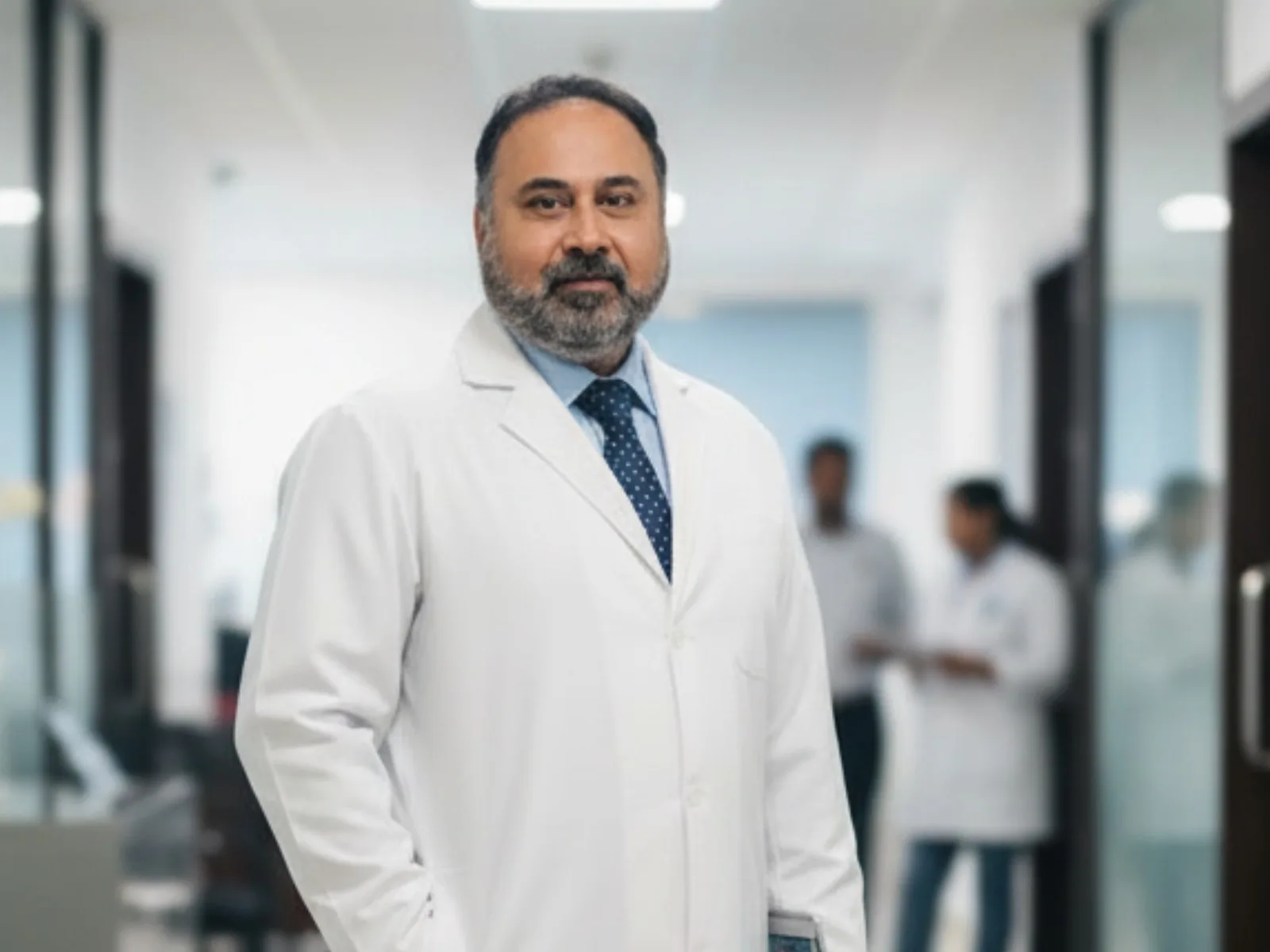
The road to Ambaji is long — 100 kilometres winding through fields, rivers, mountains, and the quiet resilience of rural Gujarat. Most people walk this path for faith. But for Dr. Ashish Dave, it’s something more.
Every December, on the birthday of his late father — 28th of December — the dates are fixed: 26, 27, 28. The walk begins from his native town of Vadnagar and ends at the sacred temple in Ambaji.
The journey winds through golden fields, quiet rivers, sleepy villages nestled between hills. It’s peaceful. Almost cinematic.
He does this pilgrimage every year with a group of 50 to 60 others. Three days on foot. No fanfare. No spotlight. Just stories, silence, and footsteps. But what makes the walk unforgettable isn’t the distance.
It’s what happens along the way.
At every turn, people are waiting. Some are elderly, others barely teenagers. Entire families stand by the roadside. Not with banners or garlands — but with tea. With snacks. With warm food and folded hands. Some bring fruits. Others offer water from their wells. They wait hours in the chill — not for celebrity, but for him.
Dr. Dave isn’t just a surgeon to them. He’s a son. A saviour. A thread that stitched someone back together when cancer tried to unravel their life.
But here’s the twist: most of these people didn’t even know him when their lives were saved.
They knew his father.
Dr. Dave walks 100 kilometres every year, and along the way, he watches strangers honour his father’s memory — the doctor who treated them when they had no money, who took grain and vegetables as payment, who became a plastic surgeon at 60 so no one in the village had to go to the city to heal.
And in these quiet roadside moments, Dr. Dave sees it clearly:
This — not the scalpel or the certificate — is what legacy looks like.
Not loud. Not rich. Not viral. Just deeply human.
The Seed Was Planted on a Table
Before he ever wore a white coat, Ashish Dave was a boy dragging over a wooden bench in the corner of the operating theatre, trying to get just high enough to see his father at work.
He wasn’t supposed to be there — but curiosity is a stubborn thing, especially when your hero is standing under harsh surgical lights, stitching hope into someone’s body. These weren’t hospital tours. They were quiet lessons in skill, in stillness, in what it looks like when compassion meets precision.
His father, once a farmer, had become a surgeon in Visnagar — a small town in Gujarat with little access to specialised care. Patients came from remote villages, often with nothing in their hands but faith. Many couldn’t afford to pay. Some brought rice. Others, a few rupees, maybe a thermos of tea. All were welcomed.
There was no marketing, no prestige. Just a deep-rooted sense of responsibility.
That sense was forged by Ashish’s grandfather — a man of few words, but immense clarity. When Ashish’s father first became a doctor, his own father told him something that would echo through generations:
“You are a Brahmin. You’ve been given the opportunity to serve humankind. Never treat this like a business. This is maha seva — a divine service. Let money be a by-product, never the goal.”
Ashish didn’t just hear that philosophy. He lived in its shadow. And when the time came to choose a path, it didn’t feel like a choice at all.
Even when he missed a medical seat in Gujarat by two marks, he didn’t quit. He packed his bags for Bangalore and joined Ambedkar Medical College — determined to walk in his father's footsteps, even if the road was longer.
But what he didn’t know then was that his journey wouldn’t just follow his father’s path.
It would amplify it.
A Path Few Would Choose
By the time Ashish Dave entered the halls of Tata Memorial Hospital in Mumbai, he was no longer just the son of a village surgeon.
He was one of only two doctors selected from over 5,000 applicants across India — handpicked to join one of the most prestigious oncology programmes in the country. It was the kind of opportunity that turns careers into empires. A place where ambition crackles in the air like static. Where reputations are made, and futures, fast-tracked.
Ashish wasn’t just surviving in that environment — he was thriving.
He trained under legends. Touched the latest technologies. Rotated across departments: breast, thoracic, gastrointestinal, plastic surgery. Every day, he learned more about how to save lives — and how far the world still had to go to reach the villages he’d come from.
His mentor, Dr. Ashok Mehta, one of India’s most respected oncological surgeons, spotted something early. Skill, yes — but also restlessness. A pull that didn’t point up, but outward.
One day, Dr. Mehta sat him down and said:
“If everyone stays here with me in the city, what will happen to the patients waiting in the periphery?”
It hit hard. Because Ashish already knew. Back home in North Gujarat, people weren’t just lacking access to care — they were dying without even knowing what was wrong.
There were no cancer centres. No trained specialists. No diagnostics. Just silence. Just distance. The closest proper facility was over 200 kilometres away.
He could have stayed.
He could have climbed the ladder. Built a name. Bought property. Flown out to international conferences.
Instead, he packed up his things, left Mumbai behind, and went home.
Carving Out Cancer Care in a Desert of Access
When Ashish Dave returned to Visnagar in 1996, there were no gleaming hospital towers, no modern oncology departments, no waiting rooms filled with hope.
Just one building — his father’s modest hospital — and a community that had never seen a cancer specialist before.
North Gujarat, especially the districts surrounding Visnagar and Mehsana, was a medical desert when it came to cancer care. From the edge of his town to the border of Rajasthan — over 100 kilometres in every direction — there was nothing.
No facilities. No screening. No early detection. No chance.
That’s where he started.
He converted part of his father’s hospital into a cancer unit — not with grand announcements, but with quiet determination. He didn’t wait for government grants. He didn’t chase private investors. He just started treating people.
In 2001, he opened a small hospital in Ahmedabad — not to leave Visnagar behind, but to extend access. Certain treatments like radiation therapy, CT scans, and MRIs were still unavailable in the village, so he built a bridge — one foot in the city, one firmly in the soil of his hometown.
But it didn’t stop there.
He started travelling. To Mehsana. To Patan. To small, often-overlooked talukas. He would perform surgeries, hold consultations, and train local medical staff to manage follow-ups. While many specialists focused on attracting patients to the city, he was moving in the opposite direction — taking care to the patients.
His vision wasn’t about empire-building. It was about erosion. Eroding the distance between a diagnosis and a fighting chance.
The work was gritty. Sometimes thankless. But it was always personal.
Because Dr. Dave wasn’t just bringing back techniques from Tata Memorial — he was planting something else entirely.
The Man Who Could Sing Again
Cancer doesn’t just take lives. Sometimes, it takes voices.
For patients with laryngeal cancer — cancer of the voice box — survival often comes at a steep cost. The surgery removes the larynx, leaving a permanent hole in the front of the neck to breathe. Patients live — but they lose the ability to speak.
Silence becomes the price of survival.
But not if Dr. Ashok Mehta had anything to say about it. And not if Ashish Dave was standing beside him.
At Nanavati Hospital in Mumbai, a pioneering technique was being introduced for the first time in India: voice restoration using the Provox prosthesis — an artificial valve implanted in the throat that allows patients to speak again after a total laryngectomy.
Dr. Mehta, along with his core team — Dr. Ashish Dave and Dr. Sudip Sarkar — performed over 100 voice restoration surgeries in a single year. Each one gave a patient more than speech. It gave them identity, dignity, connection.
For Dr. Ashish Dave, this wasn’t just another clinical rotation.
This was his greatest hands-on training — a front-row seat to learning a life-altering procedure with precision, depth, and real-world confidence.
Among those hundred patients, one stands out in his memory like a still-burning light. It was at Tata Memorial Hospital in 1991.
A quiet man. Unremarkable at first glance. He came in for surgery like many others — nervous, hopeful, silent.
What no one knew then was that he had once been a professional singer.
After the surgery, he returned. The same man — with a new voice. And in front of the very team that had rebuilt his ability to speak, he sang the very song that had once echoed through radio waves across the country:
“Tera hijr mera naseeb hai, Tera gham meri zindagi hai…” (Your absence is my fate, your sorrow, my life...) — from Razia Sultan, sung by Kabban Mirza, lyrics by Nida Fazli
The room went quiet. Then the silence cracked. And tears came — not just from the singer, but from the surgeons too.
“That moment,” Dr. Dave says, “wasn’t science. It was something beyond. We didn’t just help him survive. We gave him back who he was.”
Word spread.
A team from the Netherlands Cancer Institute and Sweden’s Atos Medical — the creators of the Provox valve — were selecting 20 doctors from across the world to train on the next-generation prosthesis: Provox 2.
They approached Dr. Mehta.
But in a moment of pure mentorship, he declined — and pointed to his student.
“Take Ashish Dave. He’s the one you’re looking for.”
At the time, Dr. Dave had no passport. No visa. No international travel history. No savings. But what he did have was purpose.
The Institute sponsored him fully.
He flew to the Netherlands, trained with pioneers, and learned advanced techniques — not only for voice restoration, but for even more complex surgeries involving the throat and food pipe. He absorbed it all.
And then he came back to Gujarat — to bring it home.
Years later, one of his first patients returned for a check-up. His voice prosthesis — originally expected to last two to three years — had lasted fifteen. He was still speaking. Still thriving.
Still singing.
Battling Broken Systems
In medicine, skill will get you far. But ethics? That’s where the road gets complicated.
Dr. Ashish Dave didn’t just bring surgical innovation to underserved regions — he brought something far rarer: uncompromising values. And that’s not always welcome.
As his reputation grew, so did invitations from hospitals eager to set up cancer units. He responded — not for fame, but because these were places no one else wanted to go. Over the years, he helped develop oncology departments in some of Gujarat’s most overlooked towns.
But here’s what they don’t tell you when you return to serve: systems don’t like to be changed.
At first, it was about building. Training staff. Setting protocols. But eventually, the politics would begin — backdoor deals, conflicts of interest, pressure to prioritise profit over people. And every time that line appeared between right and convenient, Dr. Dave made the same choice.
He walked away.
“The moment I see the wrong hands pulling the strings,” he says, “I leave. Once the machines are in place, once they’ve got the infrastructure, I move on to the next place no one’s looking at.”
It’s a pattern. He plants. They grow. Politics creeps in. He leaves.
Because for Dr. Dave, this was never about owning a hospital. It was about making healthcare reach the patient, not the other way around.
But the cost is real. Watching institutions drift away from their purpose. Seeing medicine, once noble, traded for margin and manipulation. It hurts.
And then there’s the deeper frustration — the absence of a system. The contrast between what he experienced at Tata Memorial, where full-time doctors worked in a streamlined, ethics-first environment, and the chaotic patchwork of part-time consultants in many smaller centres.
He’s seen surgeons operate for eight to ten hours while still running their private clinics on the side. Seen patients drained of savings not for treatment — but for someone’s commission.
He says what few doctors say out loud:
“This is not just unprofessional. It’s dangerous. How can you do a 10-hour surgery when you’re only in the hospital half the day?”
But the broken system hasn’t broken him.
If anything, it’s refined his focus: go where the system is absent, and build something honest before it arrives.
Legacy Doesn’t Retire
There’s a moment in every battle where the question creeps in:
Is it worth it?
When another institution buckles under politics. When another well-meaning initiative gets twisted by money. When silence would be easier than standing firm.
That’s when Dr. Ashish Dave finds himself remembering his father.
Not in grand memories — but in quiet echoes.
Like how his father stopped performing orthopaedic surgeries the moment a trained orthopaedist arrived in town. Or how he learned plastic surgery in his late fifties — not to add titles to his name, but to bring a service home that no one else was offering. Or how he never chased credit, even as he worked side-by-side with specialists from Bombay in a tiny hospital in Visnagar.
Ashish watched it all as a boy. And at the time, it felt normal. Only later did he realise how rare it was.
“He never told me what to do,” Dr. Dave says. “He showed me.”
And that legacy lives on — not just in the surgeries or the hospital — but in the way Dr. Dave chooses discomfort over compromise. The way he leaves institutions when ethics start to bend. The way he continues to serve small towns while others retire into comfort.
Some of his former classmates, now heads of departments in big cities, are stunned to learn he still goes to Visnagar three times a week.
“You’re still working there? After all these years?”
Yes. Because for Dr. Dave, this isn’t a phase. It’s a promise — not just to patients, but to the man who first showed him that medicine is not a business.
And every now and then, when the road gets heavy, something happens to lift it again.
A long-lost patient walks in, still healthy. A familiar voice speaks through a prosthetic. A family offers food on a dusty roadside during a pilgrimage.
And just like that, the reason becomes clear again.
A Call to Doctors, and to Us All
The world expects its doctors to stay in gleaming hospitals. To chase progress, prestige, and profits. And most do.
But Dr. Ashish Dave kept walking back.
Back to dusty villages. Back to patients who had never seen a CT machine. Back to the kind of places others leave once they “make it.”
He doesn’t see himself as a hero. Just a man trying to live without regret.
He could have taken the easier road. The one that leads to urban clinics, air-conditioned waiting rooms, and higher margins. He trained at Tata Memorial. Worked under legends. Studied in the Netherlands. But every time the path forked, he turned toward the people who had the least — not because he had to, but because he chose to.
Even now, decades into his career, his classmates are still surprised.
“You’re still going to Visnagar?”
Yes. Three times a week. Without fail.
Because the work isn’t done.
And Dr. Dave has a message — not just for doctors, but for anyone who feels torn between success and service:
“You don’t have to give up your life to give something back. One day. One visit. One surgery. That can change someone’s world.”
He’s seen it. Lived it.
He still remembers walking that 100km pilgrimage to the Ambaji temple. And the crowds who lined the road — not as patients, but as people who remembered his father. Offering snacks, tea, water — not out of obligation, but gratitude.
“My father never earned crores,” he says. “But he earned people.”
That’s what Dr. Dave inherited. Not land. Not a fortune. But a community that remembers. A practice built on ethics. A name carried in the hearts of those who were healed when no one else would treat them.
And now, decades later, he’s earned the same.
So the question isn’t: why did he go back?
The real question is: What might happen if more of us did?
Before you go
He was one of only two selected from over 5,000 to train at Tata Memorial. He had the path, the prestige, the proximity to global medicine. But when his teacher asked, “Who will go back to the periphery?”
Dr. Ashish Dave packed his bags and left the city — not to retreat, but to return home and serve the people no one else was showing up for.
Take a moment. Ask yourself:
When was the last time you said no to what looked impressive so you could say yes to what actually felt right?
How often do you find yourself walking away from your deeper values, just because the world around you rewards something else?
And if you zoom out — are you becoming the kind of person who moves toward what matters, or just away from discomfort?
Author's note
Dr. Ashish Dave’s story shows what real credibility looks like: when he was thriving at India’s top cancer hospital and was offered every reason to stay, he chose to return to a small town with no oncology care — because that’s where patients were dying quietly, without access or hope.
It cost him prestige, comfort, and convenience — but it gave him something else: integrity that could stand up against broken systems, and a life shaped not by spotlight, but by service.
He didn’t just treat cancer. He preserved dignity — and proved that living by your values means moving toward need, not toward applause.
By Ugesh Sarcar