Wisdom Bank - Why Not Now: The Story of Mahendrasinh C. Jadeja
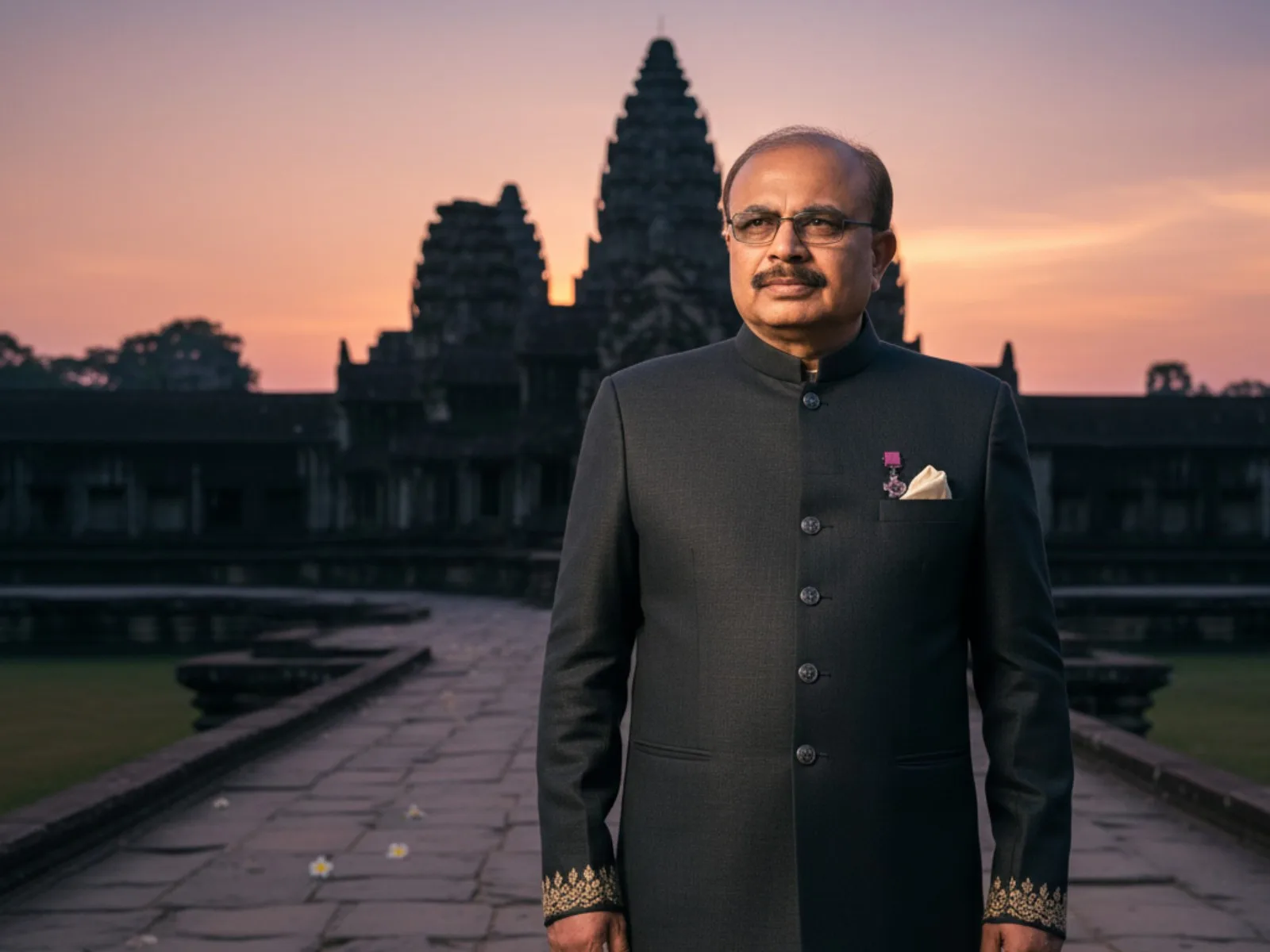
It started in the middle of the night.
Mahendrasinh C. Jadeja — or Dada, as almost everyone calls him with love — was lying in bed, staring into the darkness. A man with a lifetime of achievements behind him, titles that stretch from president to patron, awards and committees and corridors of influence. But on this night, his thoughts weren’t on power, or position. They were on silence.
He had just returned from attending International Women’s Day — a moment, as he recalled it, that left him reflective and oddly unsettled. Not because he questioned its purpose. Quite the opposite. He admired it. But something sat unspoken, wedged deep in the background like a shadow hiding behind the curtain.
What about the other half of the story?
What about men — the ones who don’t speak up, who hold pain like a locked box? Who suffer quietly through illness, shame, expectation, and never say a word until it’s too late?
That night, as he turned the letters over in his mind — IWD — a simple idea came to him.
“If I just turn the middle letter upside down... it becomes IMD.”
That spark — whimsical as it sounds — was the seed of something extraordinary. He began researching, talking, planning. What emerged wasn’t just an observance, but a movement: a call to unmute the voices of men. To talk about prostate cancer, mental health, isolation. To ask: Why do more men die by suicide than women in the UK? Why do they not tell their partners about their pain? Why do they hide?
And so, International Men's Day — his version of it — was introduced in the most symbolic of places: the British Parliament.
He didn’t wait for permission. He didn’t wait for applause. He saw something missing in the conversation, and he chose to fill the gap — not with noise, but with purpose.
The world might call him an “influencer”, a “global Indian”, a “community voice”. But to understand who Mahendrasinh Jadeja really is, you need to go back further.
Before the awards. Before the titles.
To the moment when he gave up a dream — and made a decision that would set his entire course.
The Accidental Leader
He was just a boy with a dream.
An engineering student in India with the sky in his eyes and a pilot’s uniform within reach. He had been selected — not just interested — selected for pilot training with a major airline. It was the kind of opportunity many young men would chase without looking back.
But Mahendrasinh C. Jadeja didn’t board the flight.
His mother said no.
“You’re the only son,” she told him. “If something were to happen to you, what would happen to us?”
So he stayed. No drama. No rebellion. Just a quiet decision, made out of love and duty. He never did become a pilot. Instead, he took a different kind of journey — one that would keep his feet firmly on the ground, even as his influence stretched across borders.
He soon moved to the UK. A new country. A new life. And from the ground up — quite literally — he began building.
Retail became his domain. Hard work, persistence, and a deep sense of integrity carried him through the industry. But it wasn’t just his work ethic that made him rise. It was the way he carried himself — not as someone climbing the ladder, but as someone building the ladder for others.
In 2004, he made history.
He became the first non-white national president of the retail sector across the United Kingdom — covering not just England, but Scotland, Wales, Northern Ireland, Southern Ireland, and the Crown dependencies.
There were no shortcuts. No favours. No family inheritance to smooth the way. He had come from royal lineage, yes — but he had built this path alone.
He later recalled a moment that summarised his mindset: “If you want to board a bus, you have to take the first step yourself to climb. No one else will push you on.”
That’s how he led.
And when others wanted to hold on to titles, clinging to them for years, he did something few in power are willing to do — he let go.
He proposed a rule: no president, secretary, or treasurer should hold office for more than two terms. Four years maximum. Then pass the torch.
Because true leadership, he believed, wasn’t about position. It was about creating space for the next person to rise.
And still, through all of it, he never asked: What’s in it for me?
His philosophy was simpler: Do the right thing. The rest will follow.
Crownless Legacy – The Royal Blood Who Chose Relevance Over Reverence
Mahendrasinh C. Jadeja doesn’t wear it on his sleeve. But it’s in his blood.
A quiet thread of legacy — not made of silk or gold, but of history.
He comes from the line of Sir Ranjitsinhji Vibhaji Jadeja, the man after whom the Ranji Trophy is named — one of the most prestigious tournaments in Indian cricket. Ranjitsinh was the first non-white cricketer to play for England, captaining Cambridge University, Sussex County, and making his mark in an empire that rarely made space for outsiders.
That was 1893.
More than a century later, his descendant sits in a different kind of room — not royal courts, but business halls, community gatherings, government corridors. Not with servants, but surrounded by volunteers, workers, and next-generation leaders.
“I’m proud of where I come from,” Jadeja says. “But I’ve always believed — it’s not about the family you’re born into. It’s about what you do with it.”
He never leaned on lineage. Never expected reverence. In fact, the only time the family’s royal roots surfaced publicly was during his son’s wedding — when an extraordinary gesture made headlines.
In 2008, the current Jamnagar royal family heard about his son’s upcoming wedding in Jaipur. In a rare and personal move, they opened the ancestral palace — a site usually closed to the public — and hosted the ceremony. It was the first wedding in the palace after more than 40 years.
“He came in person and said, ‘Let it be in the palace. It would be my honour.’”
That wedding, steeped in grace and tradition, wasn’t just about grandeur. It was about recognition — of a man who had honoured his heritage not by sitting on a throne, but by getting to work.
By choosing relevance over reverence.
By choosing to build his legacy, rather than inherit it.
And yet, the deeper irony remains: though the palaces may have faded from public life, Jadeja carries something nobler — the belief that leadership is a form of service, not status.
That’s the legacy he chose to carry forward.
Dada – The Leader Who Let Go
In Gujarati tradition, “Dada” is a sign of hierarchy — a name for a senior male in the family line. In Mahendrasinh C. Jadeja’s case, it referred to his place in the royal Jamnagar lineage, where “Dada” meant part of the junior branch.
But outside of Gujarat, especially in the UK, the word took on a new life.
People began calling him Dada not because of tradition, but because of trust. Across community halls, parliamentary corridors, trade forums, and cultural functions, “Dada” came to mean something more: the leader who never asked to lead, but whom people followed anyway.
He built that identity not through power, but through principle.
And one of those principles was this: leadership must end.
In every organisation he led — from the Gujarati Committee of the United Kingdom to community councils and national associations — he introduced a rule: no president, secretary, or treasurer could stay in office for more than two terms.
“If it’s not in the rulebook,” he said, “people will never give up the chair. So I wrote it in the rules.”
He didn’t impose it on others and exempt himself. He lived it. He led — and then stepped aside. Sometimes at the peak of his influence.
Because for Dada, leadership was not about control. It was about continuity.
Where others feared being forgotten, he focused on making sure what he built could survive without him. That’s real power — the kind that doesn’t need to stay visible to stay effective.
He didn’t want statues. He wanted succession.
He didn’t want praise. He wanted principles in place.
And in doing so, the name “Dada” stopped being a nod to his past — and became the clearest reflection of who he really was:
A mentor. A builder. A servant leader who knew when to let go.
The Man Who Finds Time (Even When Others Can’t)
Ask anyone today, and they’ll tell you how busy they are.
They’ll miss a meeting, skip a reply, forget a promise — and point to their calendar as proof of importance.
Not Dada.
At 72, with a lifetime of causes, travel, connections and commitments, he still picks up the phone. He still answers messages. And when someone doesn’t return his calls, he doesn’t assume the worst.
He sends a gentle message:
“I hope you’re okay. Respond when you can.”
That’s the kind of grace he operates with — not because he’s soft, but because he’s disciplined.
“A truly busy person,” he says, “will always find time. Someone who isn’t busy will always find an excuse.”
This isn’t theory. It’s how he lived with his mother, too.
Every day, at 8 a.m. India time — wherever he was in the world — he called her. Until the day she died. She passed away during one of those calls, asking her family to wait until he rang before she let go.
The discipline wasn’t in the call. It was in the presence.
The same presence he gives to every young person who reaches out. Every official who needs advice. Every event where his voice could make a difference.
And when people delay things, or keep him hanging, he doesn't argue. He moves forward. If a project doesn’t respond, he lets it go. If a partner drags their feet, he finds another route.
“Don’t bang your head on a wall,” he says. “It won’t break — but your head might.”
This isn’t a life powered by urgency. It’s powered by intention.
Because when he gives you his time, it means one thing:
He’s all in.
Building Bridges, Not Empires
You’ll never see his name plastered across institutions. No Dada Foundation. No Jadeja Tower. He’s not trying to be remembered through plaques or portraits.
He’s trying to build bridges.
Between the UK and India. Between elders and youth. Between policy and action. Between those who have ideas and those who can make them real.
He’s campaigned for low-cost flights between the UK and India — because he knows the diaspora needs more than WhatsApp to stay connected.
He’s worked with governments to enable homeopathic medicine exports from the UK to India — something that had never been done before.
He’s pushed for educational initiatives, trade relations, immigration reform, and youth empowerment — not from a podium, but through persistent connection.
And when things stall, he doesn’t waste time. His attempt to establish a medical university in another country is a perfect example. When red tape and non-responsiveness slowed things down, he paused. Gave people a chance. Then made a clear decision:
“If it doesn’t move, I move on.”
He doesn’t force things. He facilitates them. If a door doesn’t open, he builds a path around it.
And in doing so, he’s helped not just institutions, but people.
Like the young man he helped marry — the son of a friend, someone struggling with alcoholism. Dada supported his transformation, even arranged the match. When the boy turned his life around, Dada didn’t just attend the wedding — he signed the certificate, just as he had signed his father’s marriage certificate decades earlier.
The bridge, in that moment, wasn’t diplomatic.
It was human.
Why Not Now?
This is the question Dada asks everyone.
And it’s the one he lives by.
Why not now?
Why wait to help someone when you could do it today?
Why stay in a post when someone younger could take it forward?
Why hold back when your knowledge could lift someone else?
It’s not a challenge shouted from a stage. It’s a quiet philosophy, whispered through action.
He doesn't believe in perfect moments. He believes in timely ones.
And he knows — from a lifetime of service, sacrifice, connection and clarity — that the only real legacy is the one you build while you’re still here.
So when the titles fade, and the cameras stop flashing, and the awards are packed away, what remains?
A man who gave. A man who connected. A man who lived not to be remembered, but to be useful.
He’s not building an empire. He’s building others.
And for that, he asks just one thing:
If something needs to be done —
If someone needs to be helped — bold text
If something feels right but uncertain —
Why not now?
Before you go
Mahendrasinh didn’t wait for applause, agreement, or permission. He acted because something within him said: This matters.
Take a breath. Now ask yourself:
- Where in your life have you noticed something that doesn’t sit right — but stayed quiet because no one else seemed to mind?
- What truth have you been tiptoeing around, waiting for a “better moment” to do something about it?
- What’s the cost — not in noise, but in neglect — of ignoring what you already know is yours to respond to?
Author's note
Mahendrasinh C. Jadeja’s story shows what real credibility looks like: noticing a quiet discomfort most would brush aside, and choosing to honour it instead. No spotlight asked him to act. No one gave him a script. But when something felt incomplete — when one half of the conversation was missing — he responded. Not with noise, but with action. Not with blame, but with presence. That’s what makes his story unforgettable: it reminds us that the turning point isn’t always public. Sometimes, it’s the still moment when you realise… you can’t stay silent anymore.
By Ugesh Sarcar