Wisdom Bank: Satish M H: Where Commitment Becomes Character
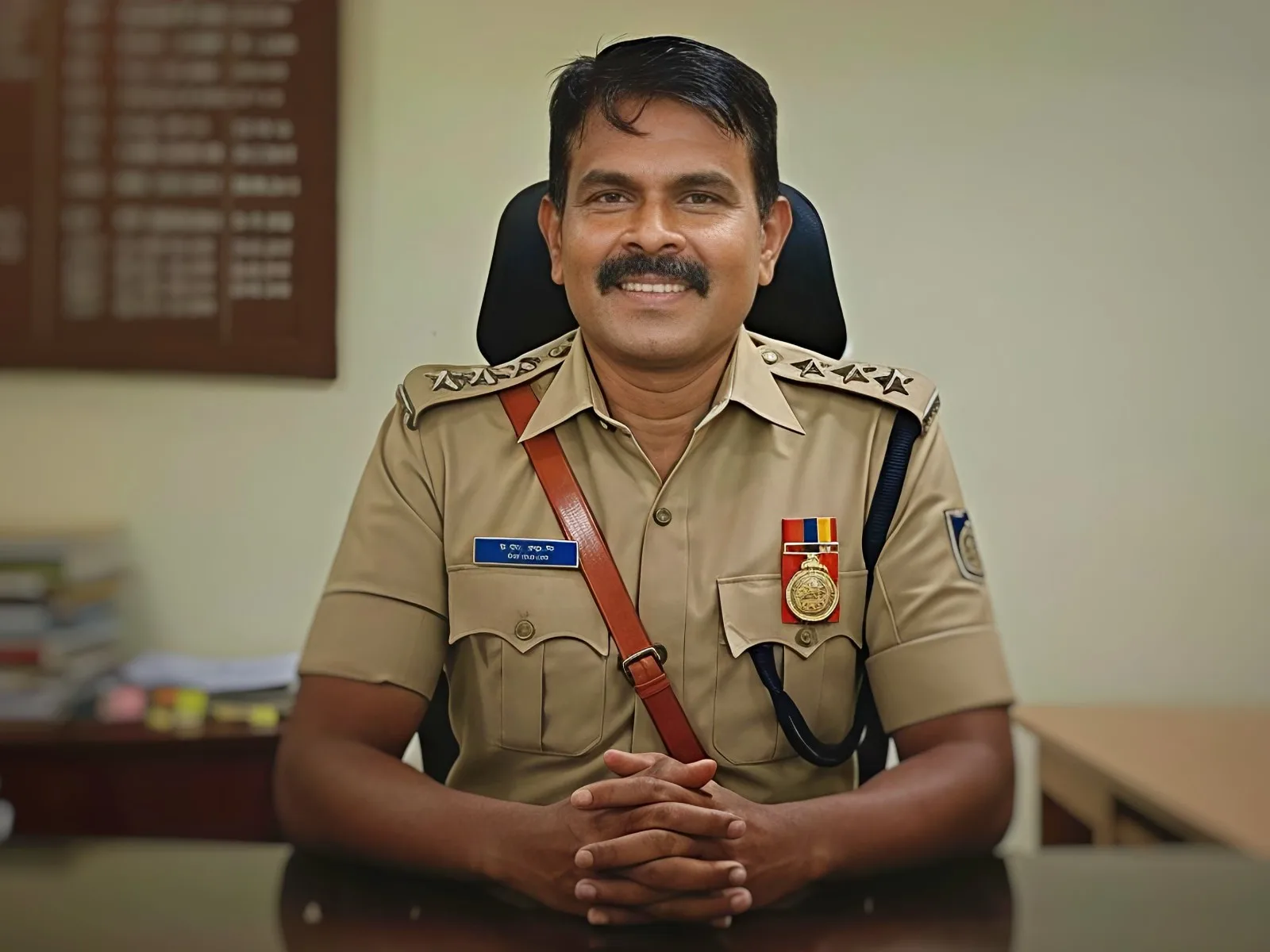
At five in the morning, before the city begins negotiating with its alarms, Satish M H is already awake.
There is no drama in it. No social media post. No motivational soundtrack playing in the background.
Just routine.
Shoes laced. Body moving. Either on the tennis court or in quiet training. Because if he doesn't, something unsettles him.
"If I don't do it," he says, "I feel guilty."
Guilty. Not because someone is watching. Not because a tournament is approaching. But because somewhere inside, a voice keeps account.
The same voice follows him to office.
He cannot sit idly. Cannot stretch a day with gossip or headlines. "I have to justify my salary," he says plainly. "I have to do something for the job I am given."
There is no grand speech attached to that sentence. No attempt to sound noble. It is simply how he operates.
Today, Satish M H serves as Deputy Superintendent with the Karnataka Lokayukta Police wing — a role that demands vigilance, integrity, and the ability to stand steady in the middle of complexity.
His service has not gone unnoticed. In 2011, he received the Chief Minister’s Medal for distinguished service. In 2020, he was honoured with the President’s Police Medal — one of the highest recognitions in the force. During his police training, he was adjudged Best Cadet at the Academy. Even then, the pattern was visible. Commitment was no longer optional. It was becoming character.
In November 2022, at the All India Police Lawn Tennis Championship in New Delhi, he secured gold in veteran doubles and silver in veteran singles — the only medal winner from Karnataka in his category.
But the medals are not the story.
The story is the discipline that existed long before the podium.
Because Satish was not always this focused. Not always this driven.
There was a time, during his college years, when commitment was optional. When responsibility felt distant.
And then, in 1995, something changed.
Not gradually.
Suddenly.
The Year Everything Shifted
In 1995, Satish was still in college, pursuing his MBA in Finance at BMS Engineering College on Bull Temple Road in Bengaluru.
He was young. Focused, perhaps — but not yet forged.
Then his father passed away in a road accident.
He had been a Deputy Superintendent of Police. Five to six years of service still left. Khaki was not just a uniform in the house — it was presence, structure, certainty.
And then it was gone.
The house still smelled like Brasso and shoe polish for months.
Grief does not arrive with instruction manuals. It rearranges things quietly. Expectations. Priorities. Posture.
"Probably after that," Satish says, "commitment and hard work came."
Before 1995, discipline was a choice.
After 1995, it became responsibility.
There is a difference.
Responsibility doesn't shout. It doesn't perform. It simply sits on your shoulders and waits to see whether you will carry it.
He was still studying. Still navigating adulthood. But something had shifted internally. The margins for carelessness disappeared. The idea of "trying later" lost its comfort.
The words he uses to describe himself today — commitment, hard work, trustworthiness — were not personality traits he proudly wore in college.
They were qualities built out of necessity.
And yet, life had another turn waiting.
Because even after his father's death, Satish did not immediately step into uniform.
In fact, for a brief period, his life was headed in a completely different direction.
The Job Within Four Walls
After completing his MBA in Finance, Satish did what many would consider the natural next step.
He secured a campus placement.
A Swiss multinational. Commercial department. Logistics.
For nearly one and a half years, he worked there — coordinating shipments, managing vendor relationships, sitting in air-conditioned meetings where the biggest emergency was a delayed container.
It was good work. Stable. Respectable.
And if you had asked him then whether he was satisfied, he would have said yes.
But years earlier, almost as an afterthought, he had applied for the Police Sub-Inspector examination.
He hadn't thought much of it.
"Government jobs," he says, "I thought they were all based on influence, bribery. So how can I get it?"
He wasn't desperate. He already had employment. So he went through the stages without expectation — physical test, written examination, interview.
And then he got selected.
Even then, enthusiasm did not rush in.
He was comfortable. Secure. The idea of stepping into the police force — a world where comfort had no guaranteed address — was not immediately appealing.
There was another layer to it.
His father, despite being a Deputy Superintendent himself, had once told him clearly: "Never join the police. If you join, join at a very senior level — like IPS."
It was advice rooted in years inside the system.
But now the decision sat before him.
Logistics spreadsheets on one side.
Khaki on the other.
Relatives stepped in.
"You are working within four walls for a company," they told him. "If you join the force, you will make a difference. You will be recognized."
And then someone said something that stayed.
"God took away that khaki when your father passed. Now He is giving it back to you."
It wasn't mystical.
But it landed.
Satish chose the uniform.
Not because he was chasing recognition.
But because somewhere between loss and opportunity, responsibility had found its address.
Loving the Work, Not the Uniform
Policing, Satish says, is not one job.
It is many lives stitched into one uniform.
You can sit in a police station. You can work intelligence. You can investigate financial frauds. You can rescue women from trafficking. You can stand security for a politician. You can dismantle drug networks.
Traffic is the most visible.
Anti-corruption is the least.
"Policing has a lot of dimensions," he says.
He says it like someone who has learned not to prefer one over the other.
Today, as Deputy Superintendent in the Karnataka Lokayukta Police wing, his work is rarely dramatic. Anti-corruption investigations are not about sirens. They are about files. Evidence. Patience. Precision.
It is slow work.
It is careful work.
And it demands something more dangerous than physical strength — restraint.
Somewhere early in his career, one of his seniors told him: "If you want to be a good cop, you should love policing."
That line stayed.
Because loving policing is different from loving the uniform.
Loving the uniform is ego.
Loving policing is responsibility.
It means you don't idle away your time. You don't measure your day by visibility. You don't treat the job like a burden.
You treat it like something entrusted to you.
That word — entrusted — matters to him.
The state has trusted him. The system has trusted him. The public, often unknowingly, has trusted him.
And trust, once given, demands effort.
There is no applause for showing up properly. No medal for not cutting corners. No headline for not misusing power.
But that is the version of policing he believes in.
And perhaps that is why, when the day ends, he does not carry the uniform home in his voice.
He carries silence instead.
Fifty Rupees
Long before medals and ranks, there was a walk.
Basavanagudi to Avenue Road.
If you know Bengaluru, you know that distance — not impossible, but long enough when you are young and counting coins in your pocket.
He was in college then. There was a close family friend whose birthday was approaching. He wanted to gift something. Nothing extravagant. Just something that said, I remembered.
But he didn't have the money.
Pocket money was limited. Asking at home wasn't an option.
So he gathered what he had — old textbooks from previous classes. Hindi was his second language. Kannada his third. He packed the Hindi books and walked to Avenue Road, where second-hand booksellers line the streets.
One shop after another refused.
"Hindi language books don't sell," they told him.
He kept trying.
Finally, someone agreed. Fifty rupees.
That was the value of his stack of books.
He took the money and bought an Archies greeting card. A nice one. Carefully chosen.
He still remembers that.
Not because it was traumatic. But because it was true.
Not the design of the card.
The walk.
The refusal.
The bargaining.
The weight of those books in his hands.
People often say money is not everything.
He smiles at that.
"Money is not everything," he says. "But money is something."
It was a small lesson. But it stayed.
Years later, when he speaks about justifying his salary, about not wasting time, about not lagging behind — it is not coming from abstract discipline.
It comes from understanding value.
The value of fifty rupees.
The value of effort.
The value of earning.
Because when you have walked forty-five minutes to turn old books into a greeting card, you do not treat opportunity casually.
You respect it.
And perhaps that respect is what carried him, years later, onto a different court — one that demanded the same quiet commitment.
The Court Beyond the Office
In November 2022, at the All India Police Lawn Tennis Championship held in New Delhi, Satish M H stood on the podium twice.
Gold in the veteran doubles.
Silver in the veteran singles.
He was the only medal winner from Karnataka in his category that year.
It sounds like a headline.
But for him, it was routine extended.
The same five a.m. discipline.
The same refusal to drift.
The same unwillingness to cut corners.
Tennis was never a late-life hobby picked up for prestige. It was part of his rhythm — something he returned to with the same seriousness he brought to office.
When he steps onto the court, rank disappears.
There is no officer there. No Lokayukta wing. No files waiting back at the desk.
Just footwork. Timing. Endurance. Strategy.
Winning matters to him.
He has always been competitive — even as a sportsman in his younger days. "We play to win," he says plainly. Not casually. Not for participation.
But defeat does not disturb him.
"If we lose, we lose. It's fine. It's a lesson."
There is no drama in either outcome.
Victory is not ego.
Defeat is not collapse.
Both are information.
The medals did not transform him.
They revealed him.
Because what wins championships at the veteran level is not raw athleticism alone. It is consistency. It is showing up. It is not skipping the mornings when no one is watching.
The same conscience that won't let him waste a workday won't let him waste a training session.
Discipline, for him, is transferable.
From Basavanagudi to Avenue Road.
From corporate cubicle to khaki.
From investigation files to baseline rallies.
Different arenas.
Same standard.
And yet, for all the public roles he carries — officer, athlete — there is a line he refuses to cross.
The uniform does not enter his home.
What He Doesn't Bring Home
Uniformed services carry a quiet risk.
The job can become the identity.
Authority can follow you into the living room.
The day's anger can sit at the dining table long after dinner is over.
Satish is careful about that line.
"The ups and downs in my professional life never affect my personal life," he says.
It isn't denial. It's discipline.
He does not narrate operational details at home. He does not bring case files into conversations. His wife, he says, is naturally anxious — and he sees no reason to transfer the weight of investigations onto her shoulders.
So he filters.
He protects.
If something difficult has happened in office, his family may notice only one sign.
Silence.
Not anger.
Not sharp words.
Just a little more quiet than usual.
That silence is not distance. It is containment.
His wife understands that rhythm. She doesn't interrogate it. She reads it.
In many ways, the strength of a uniformed officer is not just in the field — it is in the home that absorbs nothing but gives stability in return.
She holds the normalcy.
He holds the storm outside.
Between them is an unspoken agreement: work stays at work.
At home, he is not Deputy Superintendent.
He is husband.
He is father to a twenty-year-old daughter pursuing engineering at M.S. Ramaiah.
And fatherhood, like policing, is responsibility — but softer, quieter, more patient.
Five O'Clock
Every morning, the alarm doesn't ring.
Because Satish is already awake.
Five a.m.
Before the city negotiates with its snooze buttons. Before the first autorickshaw coughs to life. Before the tea stalls open.
He is lacing his shoes.
No one is watching.
No medal is on the line.
Just the same voice that has been keeping account since 1995.
The voice that would not let him idle in a corporate cubicle even when the salary was good.
The voice that walked him forty-five minutes from Basavanagudi to Avenue Road to turn old Hindi textbooks into fifty rupees.
The voice that pulled him out of air-conditioned offices and into khaki.
The voice that says: You were entrusted with something. Carry it well.
He doesn't philosophize about discipline.
He doesn't post about motivation.
He just wakes up.
And perhaps that is the entire point.
Because in November 2022, when he stood on the podium in New Delhi with gold around his neck and silver in his hand — the only medal winner from Karnataka in his category — it wasn't talent that put him there.
It was five a.m.
Repeated.
For years.
The medals did not change him.
They revealed him.
And a week later, he was back at his desk in the Lokayukta wing. Files waiting. Evidence stacking. Corruption cases requiring the same patience that baseline rallies demand.
No parade.
No headlines.
Just work.
Because titles change. Postings shift. Courts empty. Files close.
What remains is simpler.
Did you show up when no one was watching?
For Satish M H, the answer isn't in speeches.
It isn't in trophies.
It is in the alarm that never rings.
Because he is already awake.
Author's note
Satish M H’s story shows what real credibility looks like: leaving a stable corporate job to step into a uniform he had once been warned against, choosing disciplined service over comfort, and waking up at five a.m. for years without applause, shortcuts, or excuses. That choice required him to trade air-conditioned certainty for institutional complexity, to carry responsibility after personal loss, and to keep justifying his salary long after the medals were won. In doing so, he reminds us that character isn’t built in public moments of victory. It’s built in private decisions repeated long before anyone is watching.
By Ugesh Sarcar