Wisdom Bank - Ashish Vijh: The Art of Showing Up
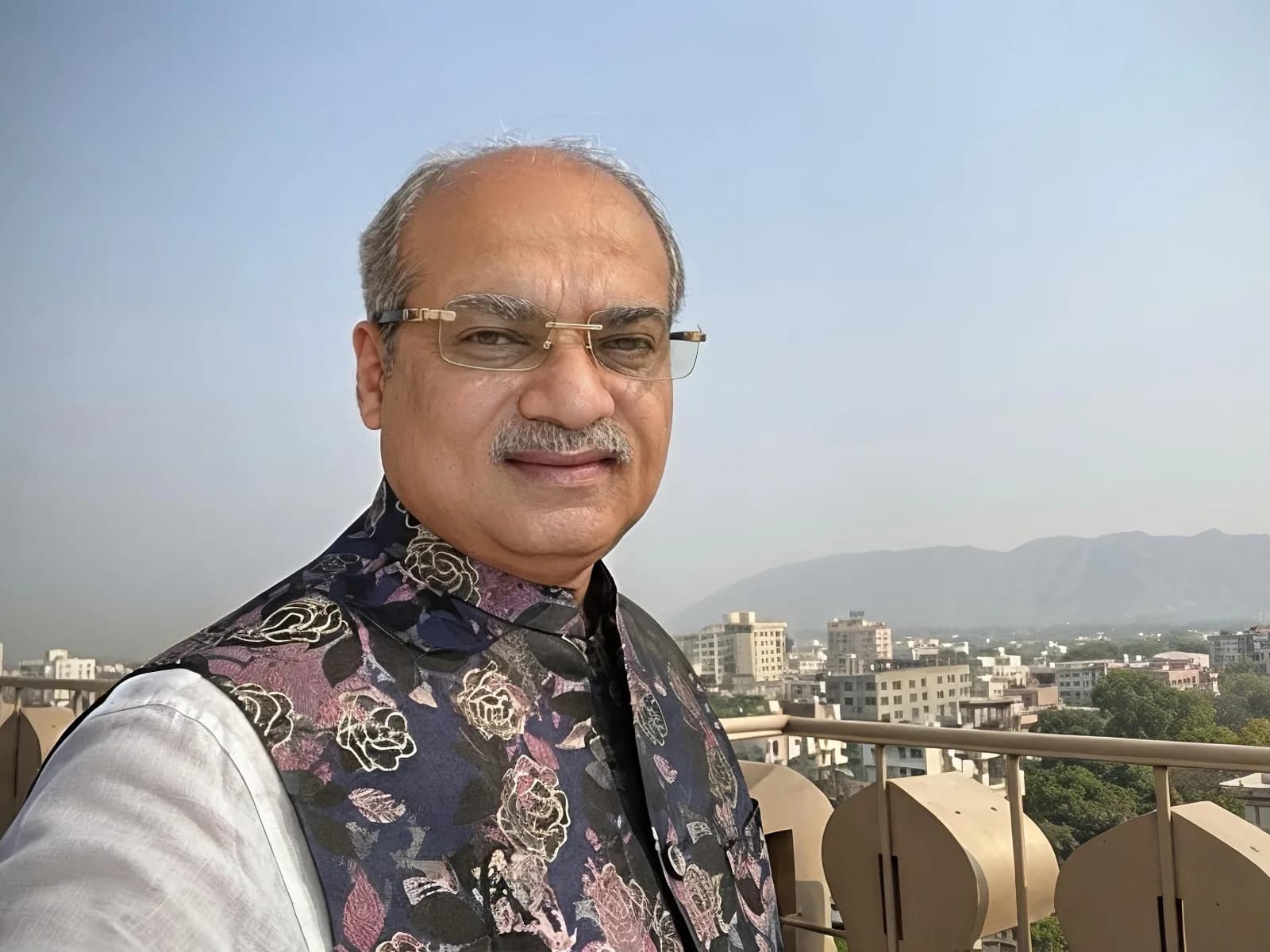
At two in the morning, most people have very good reasons for not answering the phone.
Ashish Vijh has built a reputation for being the person who does.
His friends know that if someone is in trouble, particularly in a hospital, he will come. He may stay through the night. He may make the calls that need to be made. He may take charge of whatever needs doing.
There is something revealing about the way people describe a person when they trust them completely. They do not talk about what that person owns. They talk about what that person does when things go wrong.
And that is where Ashish's story becomes interesting.
Because his life has given him plenty of reasons to become guarded.
He has built businesses, experienced extraordinary success, lost vast sums, started again and eventually made the difficult decision to close his factory. He has been cheated. He has watched businesses disappear. He has seen the kind of reversals that can change the way a person looks at the world.
Yet none of that seems to have made him smaller.
If anything, it has sharpened something that appears to have been part of him from the beginning: an instinct to look outward.
When his factory flooded, with the scale of the damage still unknown, his first question was not about the machinery or the money.
“Are my people safe?”
That one question may tell you more about Ashish Vijh than everything else in his résumé.
He Notices People
Some people enter a room and immediately notice what is happening to them.
Ashish seems to notice what is happening to everyone else.
That difference shows up throughout the interview.
When someone needs help, his instinct is to act. When a friend is ill, he does not seem satisfied with calling to ask how they are doing. He wants to be there. When somebody needs an introduction, he makes the call. When guests are travelling for a wedding, he thinks about what they might need once they arrive.
It is an unusually practical form of compassion.
He does not talk about kindness as an idea. He describes it through things he has actually done.
Someone cannot afford treatment? Find a way to help.
Workers have not been paid? Make sure they are paid.
Guests might need safety pins? Put them in the rooms.
Someone wants to travel? Find them a better flight.
A guest follows a Jain diet? Make sure they are served separately and comfortably.
None of these things, on its own, is extraordinary.
Together, they reveal a personality.
Ashish appears to have a habit of mentally stepping into another person's shoes and asking a simple question:
What would make this easier for them?
That may be one of the most useful habits a person can develop.
You do not always need to make a grand gesture. Sometimes you simply need to notice what everybody else has overlooked.
His Definition of Friendship Is Tested When It Costs Something
Ashish says he has been like this from the beginning.
That matters.
Because it would be easy to assume that generosity comes naturally when life is going well. It is much harder to understand it when the same instinct survives periods when you have less to give.
At one point, when he needed to pay his workers after his factory shut down, he sold jewellery to make sure they were paid.
His reasoning was uncomplicated.
“Where would they go?”
They were dependent on that money. He was not prepared to make his circumstances their problem.
That tells you something about how he thinks about responsibility.
For Ashish, being in a position of responsibility seems to mean carrying the weight even when it is inconvenient.
The same principle appears in his friendships.
He talks about friends he has known since school, people he has remained close to for decades. He still brings that old group together for dinners. He still pays for those gatherings.
The interesting part is not that he pays.
It is why he does it.
“Dost hain na, kya farak padta hai?”
They are friends. What difference does it make?
There is a childlike simplicity to that answer.
It cuts through the accounting that adults often introduce into relationships.
Who paid last time?
Who called first?
Who owes whom?
Who has done more?
Ashish seems to find the calculation itself exhausting.
If someone matters to you, do something for them.
If you can make something easier, make it easier.
If you can bring people together, bring them together.
Not everything has to be settled like an invoice.
He Has a Strong Aversion to Keeping Score
This may be the thread running deepest through his personality.
Ashish does not seem to think relationships should be maintained through a ledger.
He says his parents taught him something when he was young: if you give money to a friend, never expect it to come back. Otherwise, you may lose both the money and the friend.
He has experienced exactly the sort of disappointment that could make someone abandon that philosophy.
People have taken money from him and not returned it.
He has been cheated.
He could easily have concluded that generosity is a weakness.
He did not.
Instead, he seems to have separated two things that many of us mix together: being kind and being naïve.
He knows people can disappoint him.
He simply refuses to let that possibility stop him from helping the next person.
That is a subtle kind of strength.
It does not mean trusting everyone blindly. It means refusing to let one person's behaviour dictate your entire worldview.
And perhaps this is why he does not like public displays of giving.
When someone in his wider circle needed urgent money for medical treatment, he arranged ₹20 lakh, even though he did not have that amount readily available. He borrowed it from a friend and planned to pay interest.
He did not announce the contribution.
Others were sharing their smaller contributions in the group, but Ashish's instinct was to ask why anyone needed to advertise the fact that they had helped.
For him, the important part had already happened.
Someone needed help.
They got it.
End of story.
There is something deeply freeing about that way of thinking.
When you stop keeping score, you stop needing life to repay every good thing you do.
And perhaps that is why you can keep doing it.
He Believes a Good Life Should Feel Good to Other People Too
There is a lighter side to Ashish that is just as important.
He loves food. He loves travelling. He enjoys finding extraordinary places that offer real value. Friends call him for recommendations on flights, hotels and restaurants because he genuinely enjoys discovering these things and sharing them.
But even here, the same instinct appears.
He does not simply want to have a good experience.
He wants other people to have one too.
When he planned a trip to Phuket with friends, he deliberately chose a three-star hotel in the Old Town rather than the sort of luxury property they might have expected. His friends laughed at first.
Then they arrived.
The suites were around 1,200 square feet, the location was excellent and the area was known for its food. His friends ended up telling him the hotel was better than many five-star properties they had stayed in.
That is Ashish's particular kind of pleasure.
Finding something good.
Then watching somebody else discover how good it is.
It is why he spends time finding restaurants that other people might never come across. It is why friends hand him the responsibility for menus and travel plans. It is why, when organising weddings, he thinks about things most guests would never know were being thought about.
He seems to get genuine satisfaction from making an experience better for somebody else.
And that may be a more important clue to his personality than his love of travel or food.
He enjoys being the person who knows what will make people happy.
That is a very different kind of status.
It does not come from being the person at the centre of attention.
It comes from being the person quietly making sure everyone else is comfortable.
He Has Seen What Can Be Gained. And What Can Be Lost
There is an important part of Ashish's story that cannot be left out, not because it makes him impressive, but because it explains why his philosophy has been tested so thoroughly.
He has known extraordinary success.
In 1998, his general merchandise trading business had reached a turnover of ₹800 crore. He travelled constantly, flew first class and once recorded a million miles with Air France in a single year. Later, in the footwear business, he introduced Gladiator sandals in 2009 and 2010, a style that became an international phenomenon. At one point, his business was producing around 15,000 pairs of sandals a day.
Then life changed.
In 2000, he was cheated in Argentina and lost around ₹130 crore in one go. He cleared his obligations to the banks and started again. There were further losses, including during the Mumbai floods. His father fell ill with cancer and died in 2004.
Then came another rise.
Then another fall.
A major UK customer wanted credit that Ashish was unwilling to extend. The customer stopped buying, and the business eventually declined. After years of trying to keep the factory going, Ashish finally sat down with his sons and decided they should close it before they lost what they had left.
They rented out the property, cleared the banks and settled what they owed.
That is the part of the story where it would be easy to talk about resilience in grand terms.
Ashish does not.
He describes life as a seesaw.
Sometimes you are up. Sometimes you are down.
The trick, perhaps, is not to mistake either position for permanence.
When things become difficult, he keeps a low profile, reduces his expenses and gets through it. He does not seem interested in pretending that everything is fine. He simply refuses to believe that a bad period is the final period.
His sentence for those moments is almost disarmingly simple:
“Yeh bhi chale jaayega.”
This too will pass.
After everything he has experienced, it is more than optimism.
It is perspective.
He has lived through enough reversals to know that neither the highs nor the lows last forever.
He Does Not Let Life Become Smaller
Perhaps this is why the difficult chapters have not erased his appetite for life.
Ashish still loves to travel. He still loves food. He enjoys discovering restaurants, finding unusual hotels and planning holidays for friends.
He once found a business-class ticket to Amsterdam for ₹72,000. On another occasion, he found a luxury property near Da Nang for ₹45,000 a night when his friends expected it to cost far more.
He enjoys the search as much as the destination.
That is why people call him when they want to know which flight to book, where to stay or where to eat. He likes finding the place that offers something special without paying simply for the label attached to it.
Perhaps that is another lesson in how he has handled the ups and downs of life.
He has not stopped enjoying what is available simply because he has experienced loss.
He does not appear to believe that a difficult chapter requires you to stop living until the next good chapter arrives.
Life is happening now.
So find the good restaurant.
Plan the holiday.
Bring your friends together.
Make the wedding memorable.
Enjoy the meal.
Then do it again.
What Remains
There is a temptation to look at a life like Ashish's and ask how much he made.
The more interesting question is what remained when circumstances changed.
The answer seems to be people.
The friendships that survived decades.
The workers who remembered how he treated them.
The people who trusted him enough to call when things went wrong.
The school friends he still brings together around a table.
The people who still call simply to ask how he is.
That is the strange mathematics of a life lived this way.
The things he gave away did not necessarily make him poorer.
Some of them came back as trust.
Some came back as friendship.
Some came back as respect.
And some probably never came back at all.
Yet he gave anyway.
Because his philosophy was never really about getting an equal return.
It was about being able to live with yourself.
He says that if he owes somebody money, he cannot sleep peacefully. He wants to be good to people because he wants peace in his own mind.
He goes to a temple and does not ask for more for himself.
He simply says:
“Bhagwan, sabko sukhi rakhna.”
Keep everyone happy.
It is a remarkably fitting prayer for a man whose instinct, again and again, has been to look beyond himself.
Maybe that is what makes Ashish's story worth listening to.
Not that he became rich.
Not that he lost money.
Not even that he managed to start again.
It is that through all those changes, he seems to have held on to the same basic idea of what makes a life worthwhile.
Be there for people. Be fair. Be thoughtful. Keep your friendships. Help someone when you can. And when life takes something away from you, do not let it take away the person you have chosen to be.
Because the truth is, none of us knows which part of our life will survive the next turn of the seesaw.
A business can disappear.
A plan can collapse.
Money can come and go.
But somewhere along the way, if you have spent enough years showing up for people, something remarkable happens.
Your life begins to exist in other people's memories.
In the worker who remembers that you made sure he was paid.
In the friend who remembers that you stayed.
In the family who remembers that you thought of the little things.
In the person who needed help and knew exactly whom to call.
That is a kind of wealth no setback can take away.
And perhaps that is the real lesson in Ashish Vijh's story.
You cannot always decide how high life will take you or how far it will bring you down. But you can decide what kind of person will be standing there when the ground finally settles.
Ashish's answer seems to have been the same all along.
Someone who shows up.
Even at two in the morning.
By Ugesh Sarcar