Wisdom Bank - Captain Ramesh Sanil: The Pilot Who Still Feels Like a Student
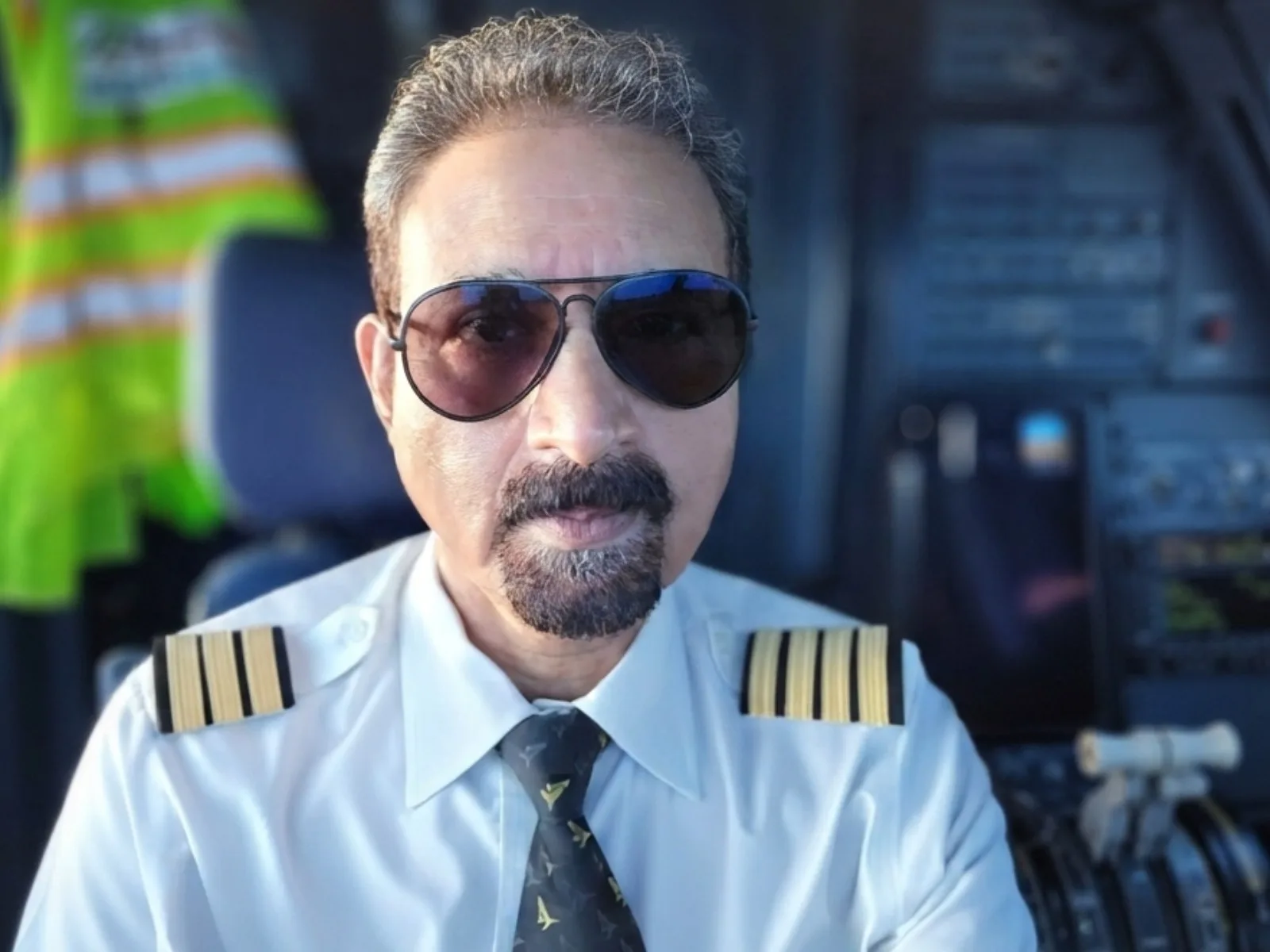
There is something quietly unsettling about being 65 and looking back at a life that, by almost any measure, should feel complete.
Captain Ramesh Sanil is approaching retirement after decades in aviation. He has spent years flying, training pilots and training instructors. There is a lifetime of experience behind him, enough to make anyone feel they have earned the right to stop learning.
But that is not how he sees it.
“I feel I have achieved only a minuscule percent of my potential,” he says.
There is no grand declaration in the way he says it. Just an honest admission that even now, he believes there is much more he could have done and much more he could still do.
For Captain Sanil, learning has never been a stage of life. It has been the thread running through it.
“If I don't learn something today that I did not know yesterday, then why do I need a tomorrow?”
It sounds like a philosophy. But listen to his story and you realise it is something much more personal.
A boy who was once mocked for the way he wrote. A young pilot who struggled to understand an instruction everyone seemed to expect him to know. A judgement written in red ink that could have stayed with him for life. An unlikely instructor who finally explained things in a way he could understand.
And then, decades spent teaching others.
Some of the most important lessons in Captain Sanil's life came from moments when he did not have the answers.
What mattered was what he did next.
The boy who kept asking why
The instinct to question things began early.
Captain Sanil remembers his father as an analytical man. He was not highly educated, but he was curious about the world. He would read the Bhagavad Gita and try to explain it to his children. He wondered about the stars, about the universe and where it ended.
He passed that curiosity on without perhaps realising it.
Years later, as a flying instructor, Captain Sanil would insist that his students understand more than a procedure.
Take a switch in an aircraft.
You can tell a student when to press it. The book can tell them when to press it. They can memorise the procedure and perform it correctly.
But Captain Sanil wants them to understand why.
Why do you press it?
What happens when you do?
And, most importantly, what happens if you don't?
For him, the consequence matters as much as the action.
It is a lesson that extends well beyond aviation. Knowing what to do is useful. Understanding why you are doing it gives you the ability to think when circumstances change.
But some of Captain Sanil's deepest lessons about teaching came from being a student himself, and later, from the students he taughtcode.
When a teacher becomes a lesson
There are certain moments from childhood that should disappear with time.
For Captain Sanil, they did not.
As a schoolboy, he was once asked to write an essay about a sunset. He reached for imagery, describing the sun against the horizon in language that made sense to him.
His teacher read it aloud to the class and ridiculed it.
The boy had written about the sun as a golden ball and the horizon as something against which it appeared to bleed.
The teacher questioned how the sun and sea could bleed.
There were other incidents.
In another piece, Captain Sanil wrote about the “cold hands of fear” gripping his heart. Again, the teacher took the words literally.
Then came the description of roads that should be “jet black”. His teacher challenged that too, pointing out that roads could be other colours.
The young Ramesh did not have the vocabulary to explain what was happening.
He simply knew how it felt.
Someone who was supposed to help him understand had instead made him feel foolish for seeing things differently.
Years later, those memories would become part of his education as a teacher.
He began asking himself a question:
What would I have done differently?
He would eventually get the chance to find out.
“You’ll never make a good pilot”
When Captain Sanil began flying, he had none of the experience you might expect from someone learning to operate an aircraft.
He could not ride a bicycle.
He had never ridden a motorcycle.
He had never driven a car.
The first machine he learned to operate was an aircraft.
He was around 17 or 18, and there were things his instructors expected him to understand that he simply did not understand yet.
One of them was the flare.
A flare is the part of a landing when the pilot gradually raises the aircraft's nose by increasing its pitch attitude, transitioning from the normal approach towards the landing attitude and reducing the rate of descent before touchdown. In jet aeroplanes, this is a relatively small pitch change, but it is a critical part of the landing.
His instructor kept telling him to flare at 15 feet.
The instruction was clear.
The problem was that it meant very little to the young student.
What exactly was he supposed to do with the aircraft when he reached 15 feet? How was he supposed to recognise that height from the cockpit? How did he know what the instructor meant by “flare”?
So he kept struggling.
While other students seemed to be getting on with their landings, he was still trying to understand what his instructor wanted.
Then one day, when his instructor was not in the office, Captain Sanil looked at his notes.
Written in red ink was an assessment of him.
He was described as being too stiff on the controls.
Then came the sentence:
“He will never make a good pilot.”
For a young person trying to find his feet, that could have been devastating.
Instead, it made him determined to prove the judgement wrong.
He would become a good pilot.
But there was still a problem.
He did not know how.
And nobody had yet explained it in a way he could understand.
The double-decker bus
There was another instructor at the flying school, a man with a reputation for being intimidating.
Captain Sanil approached him anyway.
“Sir, I have a doubt.”
What is a flare?
And how do I know what 15 feet looks like?
The instructor asked why he had not asked his own instructor.
Captain Sanil's answer was telling. Perhaps this man would hit him, he said, but he knew he would give him the answer.
The instructor laughed.
Then he explained.
He told the young pilot what a flare actually meant: as the aircraft came down towards the runway, the nose had to be gently raised, changing the aircraft's attitude so that it transitioned towards the landing position rather than continuing to descend in the same attitude.
Then came the second problem.
How would a young student sitting in an aircraft know what 15 feet looked like?
The instructor gave him a picture.
Imagine you are sitting in the front seat of a double-decker bus.
That height, that visual perspective, could give him a reference for what 15 feet looked like.
Suddenly, something abstract became something he could picture.
That was the breakthrough.
Captain Sanil did not simply learn a manoeuvre.
He learned how an instructor should teach.
A student cannot always understand a concept simply because the instructor understands it. What feels obvious to the person teaching may be completely unfamiliar to the person learning.
The responsibility, then, is not merely to repeat the instruction.
It is to find a way into the learner's world.
That experience would shape the instructor Captain Sanil eventually became.
The difference between telling and teaching
After becoming an instructor, Captain Sanil went on to spend roughly 25 to 30 years teaching. His work eventually included training instructors in how to instruct.
He sees a clear difference between giving information and actually teaching someone.
A basic instructor tells you what to do.
A better instructor notices that you are doing something incorrectly and tells you how to correct it.
But the truly good instructor asks a harder question:
Why are you not doing it?
If a student already knows they are making a mistake, telling them again that they are making it does little.
“If I knew, I would do it,” is the logic behind Captain Sanil's point.
The job of the teacher is to help the student see what they cannot yet see for themselves.
That is why the double-decker bus mattered.
The instructor did not simply repeat “15 feet”.
He gave the student a picture.
Captain Sanil carried that lesson forward.
Whenever someone does not understand something, he tries to find an example they can relate to.
It is a deceptively simple approach.
But it asks something of the teacher that expertise alone cannot provide.
You have to remember what it was like not to know.
The eyes that look outwards
There is another lesson Captain Sanil learned through teaching.
Most of us are very good at looking outwards.
We see other people's mistakes. We notice their shortcomings. We can quickly explain what somebody else should have done differently.
Looking inward is harder.
Captain Sanil believes our eyes are not naturally trained to look inside ourselves.
We see everyone else's faults. We are less comfortable examining why we are falling short ourselves.
That idea is closely connected to the way he thinks about perfection.
He describes himself as a self-perfectionist, but he does not measure everyone else against his own standards.
His reasoning comes from experience.
He knows he is not perfect. He has discovered his own limitations. So why assume everyone else should be capable of exactly what he can do?
He gives a simple example.
If 70 per cent is the required passing mark in aviation, then 70 per cent is enough. The fact that he might score 99 or 100 does not mean somebody else must.
People have different limits.
Different circumstances.
Different abilities.
His job is not to turn his own standard into somebody else's burden.
That may be one of the quieter lessons in his story.
Being demanding of yourself does not require you to be unfair to everyone else.
The quiet boy who learned to make people laugh
There is another contradiction in Captain Sanil's story.
The man who spent decades at the front of classrooms was once deeply introverted.
He traces part of his evolution to sibling rivalry.
His elder brother was the mischievous one, the child everyone noticed. His mother and neighbours would talk about how naughty and charming he was.
Ramesh would sit quietly and listen.
Eventually, he began wondering why nobody paid the same attention to him.
So he started doing something about it.
He became more mischievous. He began seeking attention. He learned to put himself forward.
And humour became one of the ways he connected with people.
Even now, he likes making people laugh. He admits that not every joke is funny, but he keeps trying.
His philosophy is wonderfully uncomplicated.
If he cannot make at least one person laugh in a day, what right does he have to smile himself?
There is something deeply human in that.
The humour is not presented as a grand talent. Sometimes the joke is silly. Sometimes the wordplay works. Sometimes it does not.
But he keeps trying to bring a little lightness into the room.
It also explains something else about him.
He may still be an introvert underneath it all, but when something needs to be done, he is willing to step forward.
Even when he does not particularly want to.
His internal conversation is almost amusingly familiar.
“I don't want to do it.”
Then comes the realisation:
“Somebody has to do it, yaar. And you can, so you do it.”
That sentence may explain more about his approach to life than any formal leadership philosophy could.
Sometimes you step forward not because you want the role, but because you know you can do something useful.
Learn from mistakes that are not yours
Captain Sanil has another piece of advice for his students:
Learn from other people's mistakes. You will not live long enough to make all the mistakes yourself.
It sounds obvious.
Yet much of life is spent learning the hard way because we assume experience only counts when it happens to us.
His approach is different.
Pay attention to what happened to the person before you.
Understand what went wrong.
Ask why.
Then perhaps you will not have to repeat the same mistake yourself.
It is the same thread that runs through his approach to flying, teaching and life.
Do not merely memorise.
Understand.
Do not merely correct.
Explain.
Do not merely judge.
Look inward.
And do not assume that every lesson has to arrive through your own pain.
Other people's experiences are lessons too.
The next chapter
Captain Sanil is now preparing to retire in November.
For the last few months of his career, he has been taking things a little easier and doing the basic minimum flying.
He wants time with his family.
His son got married in February, and he is looking forward to spending time together as a family of four. He wants to travel with his wife and visit some of the places he has missed seeing over the years.
As for what comes after that, he does not have a perfectly formed answer.
Perhaps he will continue instructing.
Perhaps he will do something else.
He has a few things in mind, but he has not decided.
And that uncertainty seems perfectly comfortable to him.
Some of the biggest roles he has taken on arrived without a long plan.
Five days before becoming a building society secretary, he had no idea he would be doing it.
When he became involved with the Indian Commercial Pilots' Association, he did not know five days earlier that he would take on that role either.
The opportunity appeared.
Something needed to be done.
And when nobody else was doing it, he stepped forward.
He trusts that something similar will happen again.
He does not know exactly what the next chapter will look like.
But he knows there will be one.
Still learning
Perhaps the most remarkable thing about Captain Sanil is not the number of years he has spent in aviation.
It is that after all those years, he still considers himself unfinished.
At 65, with retirement approaching, he looks back and sees only a fraction of what he believes he was capable of achieving.
There is no bitterness in that admission.
There is curiosity.
He wants to see more.
He wants to spend time with his family.
He may want to teach.
He may want to try something entirely different.
And, above all, he still wants to learn.
One of the thoughts he writes and shares with people captures it perfectly:
“Death is not when you stop breathing; death is when you want to stop learning.”
The line lands differently once you know where he came from.
The boy whose imagination was laughed at.
The teenager who did not understand what his instructor meant by “flare at 15 feet”.
The young pilot who found a red-ink judgement saying he would never make a good pilot.
The instructor who finally showed him what 15 feet looked like by asking him to imagine the front seat of a double-decker bus.
And then the man who spent decades teaching others.
Perhaps that is the real lesson in Captain Ramesh Sanil's story.
You do not need to know everything to move forward.
You need to remain willing to learn.
You need enough humility to admit when you do not understand.
Enough courage to ask the question.
Enough resilience to keep going when somebody has judged you too quickly.
Enough self-awareness to recognise your own limits.
And enough generosity to remember that the person beside you may need something explained in a completely different way.
The young pilot who once struggled to understand an instruction eventually became the instructor who understood that repeating an instruction is not the same as teaching it.
Now he is approaching another kind of landing.
But there is no sense that he has reached the end.
He has places he has not seen, things he has not tried and lessons he has not learned.
He does not know exactly what comes next.
For someone who has spent a lifetime learning to read what lies ahead, perhaps that is not uncertainty at all.
Perhaps it is simply another horizon.
And he is still curious about what is beyond it.
By Ugesh Sarcar