Wisdom Bank - Jimmy Nozar Amrolia: What Do You Do When You Don't Know What Comes Next?
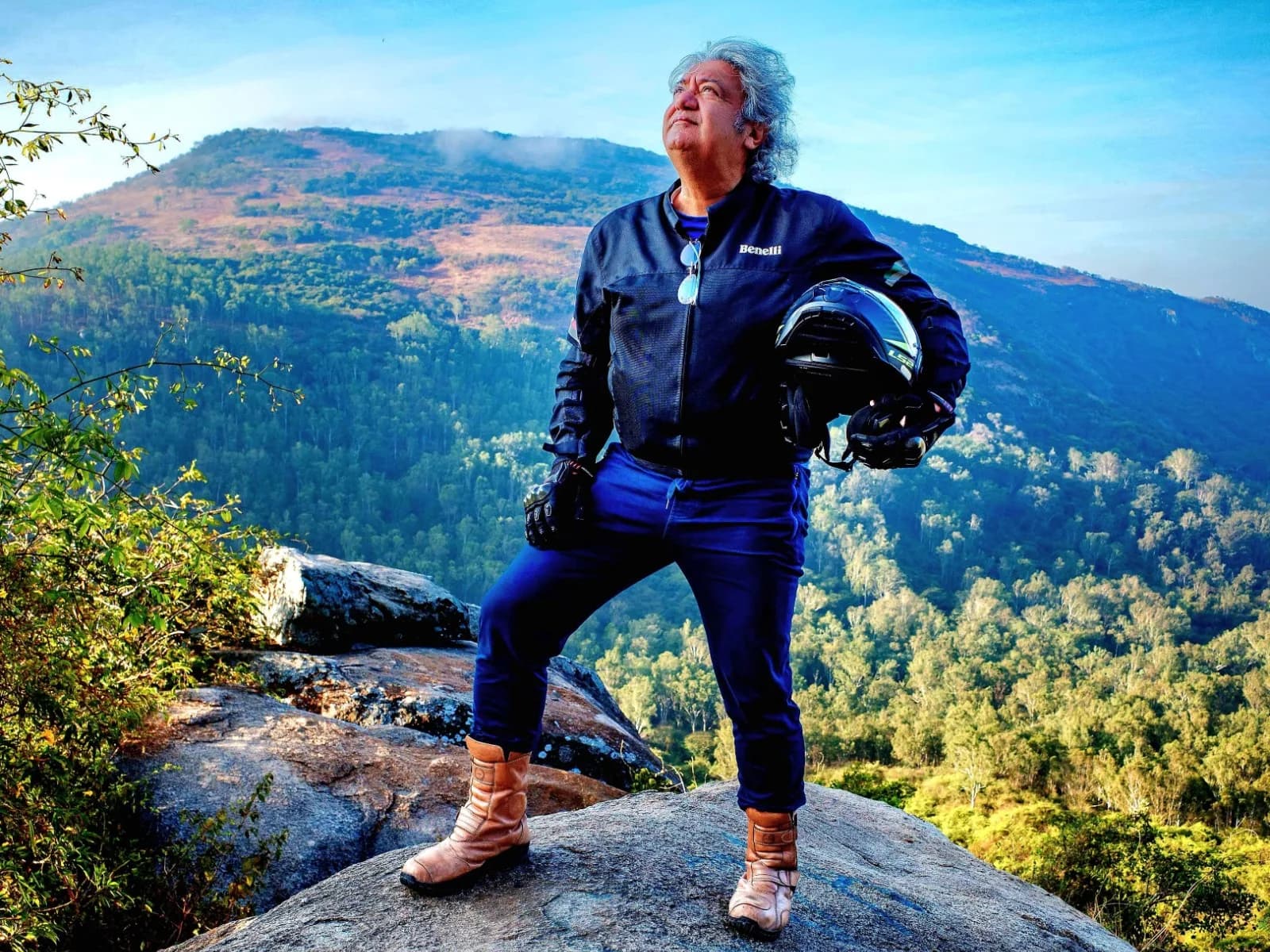
Every day, Jimmy Nozar Amrolia would look at the work in front of him and wonder what he was going to do the next day.
There were enormous rocks to move. Land to shape. A garden to build.
And, by his own admission, he had no idea what he was doing.
He would climb onto a JCB or a tractor, get to work, and somewhere in the middle of all that noise and earth, quietly pray:
“Oh God, I don't know what to do tomorrow. Please help me out.”
Then he would come back the next day and do it again.
That might sound like an odd way to build confidence. It is probably closer to how confidence is actually built.
Not by knowing exactly what you are doing, but by being willing to return when you still don't.
To understand why Jimmy found himself there, surrounded by earth, machinery and enormous rocks, you have to go much further back.
Because his life had rarely moved in a straight line.
Before He Knew Where He Was Going
Ask someone successful what they always wanted to become and you will often get a wonderfully tidy answer.
Jimmy's answer is anything but tidy.
He wanted to be a chocolate expert.
Then he tried to become a naval officer.
Neither worked out.
Eventually, he went into organic horticulture.
It is an amusing sequence when told in retrospect, but there is something important hiding inside it. We are often taught to think of a career as a line. Choose a destination, make the right decisions and keep moving towards it.
Jimmy's life was more like a series of turns.
And his earliest years had already taught him that life does not always ask permission before changing direction.
His father died in a train accident when Jimmy was five. He describes what followed as a tough life, a time when everything was hard to come by.
He went to boarding school, where the experience was difficult but formative. He says it made him physically and mentally stern and taught him discipline.
That discipline stayed with him.
He speaks about it in simple terms: keeping people's time, doing things properly, having discipline in different forms.
It is easy to treat discipline as a word that belongs on a motivational poster. In Jimmy's story, it is much more practical.
It is what you fall back on when circumstances are not cooperating.
You may not know where you are going. You may not even like where you are.
But you can still decide how you show up.
And sometimes, that is enough to get you to the next turn.
The Door That Closed
After getting married, Jimmy found himself having to leave home.
It was another unexpected turn, and there was no obvious plan in front of him.
Then someone appeared at his doorstep.
Jimmy remembers the person as an “angel”.
The invitation was simple:
“Come work with me.”
That was enough to set another chapter in motion.
Before leaving Bombay, Jimmy had spent nearly two decades doing organic horticulture on his own farms outside the city. He had also designed the garden around his bungalow, and the garden had become something people noticed. They would come to see it and photograph it.
One of those people was Bob Christo.
Bob and Jimmy became close friends. Bob would visit Jimmy's house, have dinner, go swimming and then return to his work in film and television production.
One day, Bob asked whether Jimmy would mind if Zarine and Sanjay Khan came to see the bungalow. They came.
Sanjay Khan saw the garden and wanted Jimmy to work on a project in Bengaluru.
Jimmy left Bombay and came to Bengaluru.
Golden Palms was a 150-room hotel, and Jimmy was being asked to create its landscape.
There was just one problem.
Jimmy did not feel qualified.
He told them plainly:
“I am angutachhaap. I have no idea what to do.”
The response was even more striking.
“I have full faith in you. You'll do a fantastic job.”
So he went.
That moment contains a lesson that reaches far beyond landscaping.
Sometimes another person sees a capability in you before you have evidence for it yourself.
When that happens, you have a choice. You can wait until you feel ready, or you can accept that readiness may have to come after the decision.
Jimmy chose the latter.
He found himself operating around JCBs and tractors, bringing in huge rocks from outside areas and figuring out how to turn an enormous piece of land into something coherent.
And every day, he wondered what tomorrow would bring.
He prayed.
Then he returned to work.
About a year later, the garden came together.
Magical.
But the real test came when the hotel opened. Jimmy's first major responsibility was to be the owner's representative. His first big task was getting Hrithik Roshan's marriage organised at Golden Palms, with the glitz, glamour and world media attention focused on the hotel.
It was there that Jimmy says he learnt an important lesson about VIP culture and behaviour. From that point on, everyone was a VIP to him, whether it was the Prime Minister or the housekeeper. He gave each person the same response and the same respect.
The significance of the Golden Palms story is not that Jimmy somehow knew how to do everything. It is that he started doing the work while he was still figuring it out.
That is an uncomfortable idea in a culture obsessed with expertise.
You are often told to become ready first.
Jimmy's experience suggests that sometimes the work itself is where you become ready.
When One Chapter Ends
Jimmy spent ten years looking after the hotel.
Then the owner sold it.
Once again, something that had become part of his life came to an end.
This time, the opportunity came from an entirely different direction.
The owner of Reliance had stayed at the hotel, and Jimmy was offered work involving government departments.
It was a completely different world from horticulture and hospitality.
He took it.
His work with Reliance began with launching retail stores across Karnataka. Later came Jio, where he was involved in its launch, followed by work involving government liaison in Karnataka. Today, he is also working on a clean-energy project.
From the outside, the sequence is difficult to predict.
From Jimmy's perspective, perhaps the lesson is simpler.
When something ended, he dealt with what was in front of him.
He did not need to know where every decision would eventually lead.
He just needed to take the next one.
The Blue-and-White Nokia
When Jimmy arrived in Bengaluru in 1999, he says he came with little and started from scratch.
Then a friend from the hotel industry gave him a mobile phone.
A Nokia.
Blue and white.
Small.
2G.
Jimmy remembers it decades later.
He started meeting people.
And then he kept meeting people.
Eight or nine months passed.
One day, he wondered why he could not enter any more names into the phone.
He had reached its limit.
There were 800 names in it.
Eight hundred people in less than a year.
What makes the story memorable is that Jimmy did not set out to build a network of 800 contacts.
He says he simply made friends.
That difference matters.
Networking is often presented as a strategy. You meet someone, exchange details and ask what they can do for you.
Jimmy's approach sounds much more human.
He describes himself as “fluid and open”. People came over. He hosted them. He would sit with them, laugh with them and let them be themselves. He says he likes finding people who can make him laugh.
He was not trying to turn every interaction into an opportunity.
He was making room for people.
The lesson is not that you should try to accumulate 800 contacts.
It is almost the opposite.
If you want better relationships, stop treating people like contacts.
Be curious about them. Make room for them. Give without immediately calculating the return.
The most valuable relationships in your life may not begin with a strategic objective at all.
They may begin with dinner.
A conversation.
A joke.
A shared evening.
Or simply making someone feel welcome.
The Three Things He Carries
For all the twists in Jimmy's life, his personal philosophy is surprisingly simple.
When asked what his founding principles are, he names three:
Wisdom. Honesty. Love.
Wisdom, for Jimmy, means acquiring knowledge and continuing to learn.
For the past three years, he has also been learning spiritual teachings from a Zen master whom he describes as his teacher.
That idea of lifelong learning fits the way Jimmy talks about his life. He has repeatedly found himself in situations where he had more to learn.
Perhaps that is why wisdom, in his definition, is not about having all the answers.
It is about continuing to acquire them.
Then there is honesty.
Jimmy considers it something inborn.
He also acknowledges that it has come with plenty of setbacks.
He has faced situations where people were dishonest. He has seen the downside of doing things differently.
Yet he says he does not let it bother him.
His belief is that people who act dishonestly accumulate their own negative karma.
Whether or not you share that belief, there is a useful principle underneath it.
You cannot always control what another person does to you. You can control what their behaviour turns you into.
If somebody cheats you, you can become more cynical.
If somebody misuses your generosity, you can decide never to help again.
If somebody behaves badly, you can convince yourself that behaving badly is simply how the world works.
Or you can remain on your own path.
Jimmy chooses the last option.
Then comes love.
His definition is not sentimental.
It is practical.
Be open-minded. Be there for people who need you.
If someone needs material support, help if you can.
If someone needs mental support, be there.
If someone simply needs somebody to show up, show up.
Jimmy knows that this can backfire. He openly admits that people misuse his willingness to help.
But he does not appear to see that as a reason to abandon the principle.
Experience can make you wiser without making you harder.
You can learn that people will disappoint you without deciding that everyone will.
You can become more discerning without becoming closed.
That may be one of the hardest forms of maturity.
The Restlessness to Keep Moving
Perhaps the best way to understand Jimmy is to notice that he still does not seem particularly interested in standing still.
He says that every year, he tries to do something new or something different.
Earlier this year, he decided he had become too sluggish, so he joined a gym next to his office. Now he goes six days a week for morning instructor-led classes, including mixed martial arts twice a week. In the evenings, there is badminton.
This is despite the injuries he has accumulated over the years.
He used to cycle as well, sometimes covering 100 to 150 kilometres every weekend. He eventually stopped because the traffic had become too difficult.
So he changed the activity, not the instinct.
These days, Sundays mean motorcycle rides with a few friends.
It is a small detail, but it says something large about how Jimmy approaches life.
When one road becomes difficult, find another.
When circumstances change, adapt without surrendering the impulse to keep going.
That may be the deeper meaning of the word fluid, which Jimmy uses to describe himself.
Being fluid does not mean having no direction.
It means refusing to become rigid about the route.
The Things That Remain When Plans Don't
Look closely at Jimmy's story and you begin to notice that the jobs are not really the main story.
The titles change.
The industries change.
The circumstances change.
The principles remain.
Discipline came from difficult years. Openness helped him navigate uncertainty. A willingness to learn allowed him to step into unfamiliar territory. And when people disappointed him, he chose not to abandon his belief in helping others.
There is a quiet consistency beneath all the apparent change.
That may be why his story feels less like a conventional success story and more like a lesson in adaptability.
Because adaptability is not simply changing direction.
It is knowing what not to change while everything else is moving.
“I'm Just Thankful Every Day”
Eventually, the conversation comes back to the question that sits underneath almost every difficult life:
What do you tell yourself when things are going badly?
Jimmy's answer is immediate.
“I'm just thankful every day.”
He thanks the Lord. He thanks the universe. He is thankful for what he has.
He says he does not need much.
But he has many things to do.
There is no elaborate philosophy attached to it.
Just gratitude.
Every day.
The simplicity of the answer hits differently once you know the story behind it.
This is a man who lost his father in a train accident at five.
A man who remembers a childhood where everything was hard to come by.
A man who was asked to leave home.
A man who arrived in Bengaluru with little and began again.
A man who once stood in front of a huge landscaping project wondering what he would possibly do tomorrow.
A man whose career took him into industries he could never have predicted.
And after all of that, when asked what keeps him going, he does not talk first about ambition.
He talks about being thankful.
Maybe gratitude is not pretending that everything is fine.
Maybe it is recognising that even when you do not know what tomorrow holds, there is still something in today worth holding on to.
And Perhaps That Is the Point
Near the end of the conversation, when asked if there was anything else he would like to add, Jimmy gives a characteristically simple answer.
His answer is almost disarmingly modest.
“I'm plain lucky, that's all.”
It is easy to leave it there.
But his story makes the word lucky more complicated.
Luck may open a door. It cannot make you walk through it.
It cannot make you accept a job you feel unqualified for. It cannot make you keep learning when the path changes. It cannot make you stay open to people after some have disappointed you.
Those are choices.
Jimmy's life has been full of turns he could not have anticipated. What remained within his control was how he met them.
Perhaps that is why his three principles feel less like a philosophy he created and more like something he has tested over time.
Wisdom. Honesty. Love.
Keep learning.
Stay true to your path.
Be there for people who need you.
And when circumstances change, adapt without losing yourself in the process.
There is no promise in any of this that life will become easier.
Jimmy's story offers something more useful.
You can build a meaningful life without knowing exactly how it will unfold.
You can be uncertain and still take the next step.
You can be disappointed and still remain generous.
You can change direction without losing your sense of who you are.
And you can reach a place you never imagined without forgetting to be grateful for the road that brought you there.
Perhaps, in the end, Jimmy's greatest lesson is not about success at all.
It is about staying open.
Open to the person who appears at your doorstep.
Open to the work that frightens you.
Open to the possibility that your next chapter may have nothing to do with the one you planned.
Open enough to keep learning.
Open enough to keep giving.
Open enough to keep moving.
Because in the end, you don't build a life by knowing every turn in advance.
You build it by being willing to return tomorrow, get on the machine and begin again.
By Ugesh Sarcar